Newsroom


An extraordinary cosmic explosion detected by China's Einstein Probe (EP), also known in Chinese as Tianguan, could mark the first direct observation of an intermediate-mass black hole (IMBH) tearing apart a white dwarf. The discovery—one that yields critical insights into these elusive "seed" black holes—was enabled by the satellite's innovative X-ray telescopes.
The study, led by researchers from the National Astronomical Observatories of the Chinese Academy of Sciences (NAOC), was recently published in Science Bulletin.
The breakthrough occurred on July 2, 2025, when the EP's Wide-field X-ray Telescope (WXT) picked up an unusually bright transient source during routine sky surveys. A follow-up analysis uncovered a anomaly: the WXT had detected X-ray emissions from the same celestial location nearly 24 hours before NASA's Fermi satellite recorded the associated gamma-ray bursts.
"The early X-ray emission makes this event distinct from typical gamma-ray bursts," explained Dr. LI Dongyue, a co-first author of the study from NAOC. "Gamma-ray bursts normally begin with a sudden gamma-ray flash, but here, the central 'engine' activated first in the X-ray band—signaling a truly exceptional cosmic phenomenon."
The discovery spurred a rapid international multi-wavelength observation campaign to study the event, which was pinpointed to a galaxy approximately eight billion light-years from Earth. The EP's Follow-up X-ray Telescope (FXT) then tracked the dramatic evolution of the celestial object over the subsequent 20 days, until the source became undetectable.
Around 15 hours after the initial flare, the WXT captured intense X-ray outbursts peaking at a remarkable 3 × 1049 erg/s—ranking among the brightest transient cosmic events ever observed. FXT observations revealed a sequence of changes: following a powerful initial burst lasting roughly one day, the source's brightness plummeted by more than 100,000 times. Simultaneously, its X-ray spectrum softened, a signal pointing to the emergence of a new radiative component.
The extreme brightness, rapid variability, and emissions spanning the X-ray and gamma-ray bands all point to the presence of a powerful, highly collimated relativistic jet oriented close to the observer's line of sight. Data analysis indicates the jet had a bulk Lorentz factor of at least 56, on par with those observed in previous jetted tidal disruption events (TDEs).
"No known gamma-ray burst or galactic outburst displays this exact combination of characteristics," said associate Prof. ZHANG Wenda, co-lead author of the study from NAOC. "The unique properties of this event contradict all existing theoretical models."
The research team hypothesized the event was most likely caused by an IMBH shredding a white dwarf and launching a relativistic jet—a claim supported by four key observational findings. First, an X-ray precursor was detected 24 hours prior to the gamma-ray burst, a feature inconsistent with standard gamma-ray burst models. Second, the event's extreme brightness and X-ray-to-gamma-ray emission profile confirm the presence of a highly collimated relativistic jet. Third, the source exhibited rapid evolutionary dynamics, with its brightness dropping by more than five orders of magnitude within 20 days. Fourth, a thermal radiation component may have emerged in the late stages of the event, indicating the formation of an accretion disk following the tidal disruption of the white dwarf.
In comparison to typical TDEs, this cosmic event showed an earlier X-ray decline, higher jet energy, and a far shorter fading timescale—measured in days rather than years. Its peak X-ray luminosity was also at least an order of magnitude greater, and up to 100 times higher, than that of all previously known TDEs. The researchers noted these features form a consistent physical picture and thus provide evidence for the IMBH-white dwarf tidal disruption scenario.
"The rapid brightness decay coupled with extreme luminosity suggests the disrupted object was far denser than a typical star," Prof. ZHANG further explained. "Only an IMBH—with a mass ranging from 102 to 105 solar masses—could tear apart such a compact celestial body without immediately consuming it entirely."
Additionally, independent data from NASA's Fermi satellite provided constraints on the black hole's mass. Associate Prof. YANG Jun of Zhengzhou University, a co-first author of the study, stated: "The rapid flux variability of the source points to a black hole with a mass of no more than 75,000 solar masses, effectively ruling out the possibility of a supermassive black hole as the central object."
If confirmed, the discovery would represent the first unambiguous detection of an IMBH shredding a white dwarf and furnish critical evidence for the existence of the elusive population of IMBHs.
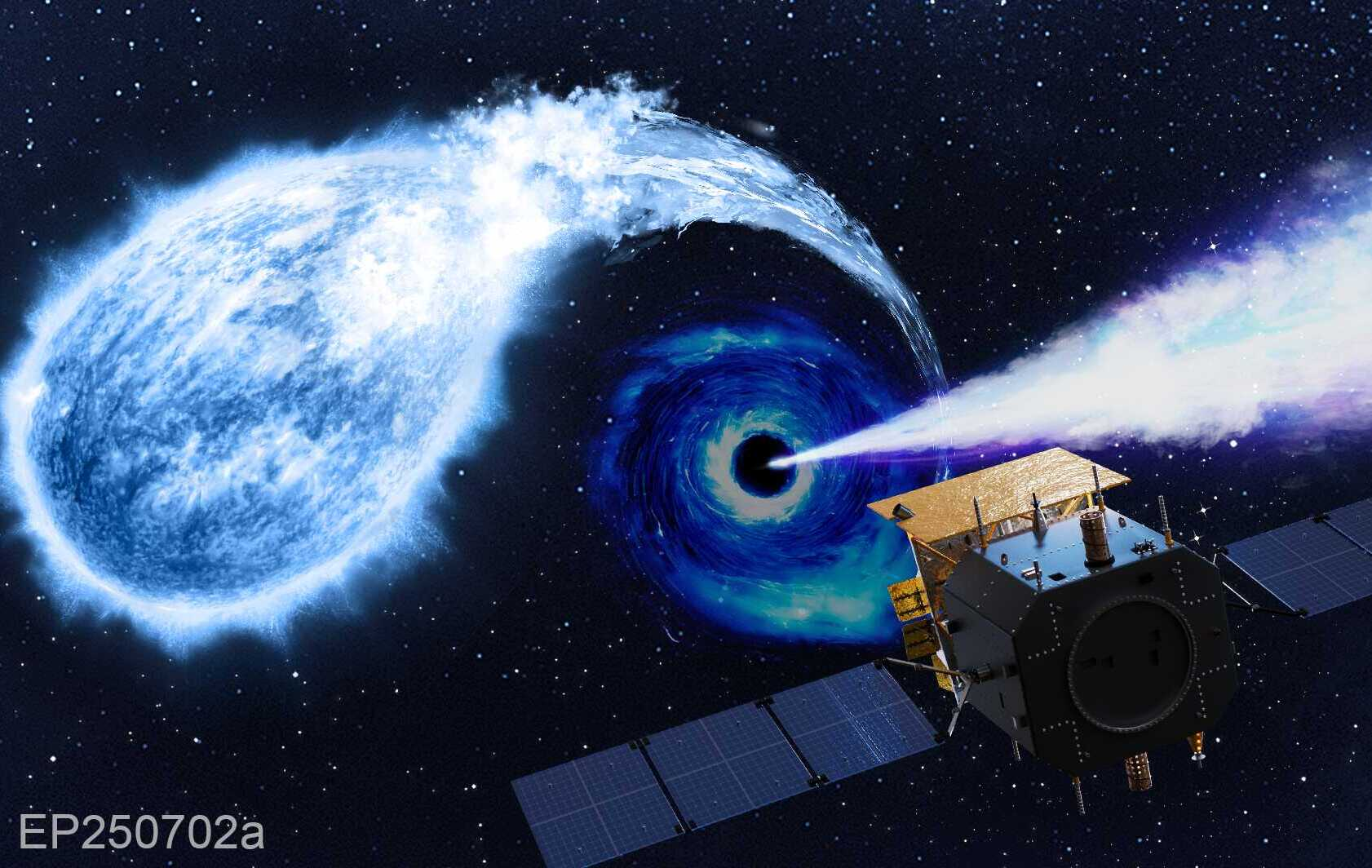
Artist's impression of the Einstein Probe satellite catching an intermediate black hole, tearing apart a white dwarf, and producing a relativistic jet. (Image by Einstein Probe Science Center, National Astronomical Observatories, CAS/Sci Visual)