Newsroom


A research team led by Prof. LIU Lingli from the Institute of Botany of the Chinese Academy of Sciences (IBCAS) has identified canopy structure as a critical regulator of ecosystem carbon use efficiency (CUE) in semi-arid grasslands.
The findings, published in Journal of Ecology on January 2, provide compelling evidence that deepened snow cover enhances the ecosystem CUE by improving the photosynthetic carbon uptake relative to respiratory loss in temperate grasslands. The study shows that this response is driven by the interaction of two key pathways: resource-mediated physiological processes and canopy-structure mediated biophysical processes.
To uncover these mechanisms, the researchers conducted a five-year experiment manipulating snow in Inner Mongolia. They also combined multi-year, high-frequency observations of ecosystem carbon flux, species surveys, and canopy structure analysis during the growing season in temperate grasslands. The researchers found that deepened snow increased soil nitrogen and water availability, which enhanced nutrient uptake and plant nitrogen use efficiency (NUE) synergistically.
Concurrently, C3 grasses characterized by higher NUE and greater height became dominant in deep-snow plots, further elevating community-level NUE.
Enhanced NUE enabled plants to accumulate greater biomass and develop larger canopy volumes while allocating less carbon to basic metabolic maintenance. As canopies expanded and became denser, they captured more sunlight and increased carbon uptake.
In addition, the enlarged canopies also created stronger shading effects, lowering temperatures beneath the canopy, especially at night. This suppressed heterotrophic respiration.
Together, these processes increased ecosystem carbon uptake while reducing carbon release, ultimately strengthening the capacity of temperate grasslands to retain carbon during the growing season.
This study highlights the critical role of canopy structure-mediated biophysical processes in regulating grassland carbon sink dynamics. These findings also underscore the importance of optimizing and managing vegetation structure in grassland conservation and ecological restoration practices.
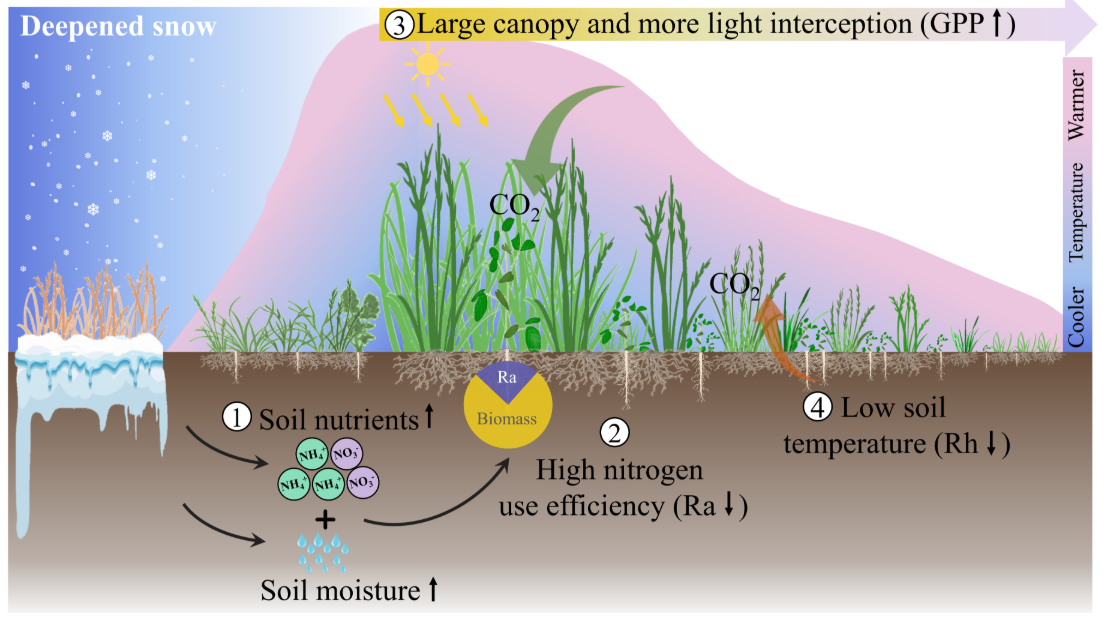
Biophysical regulation of ecosystem carbon use efficiency through nitrogen use efficiency and canopy structure under deepened snow (Image by LI Ping)

A panoramic view of the experimental field site (Image by LI Ping)