
Newsroom


A research team from the National Time Service Center of the Chinese Academy of Sciences systematically examined how uncalibrated code biases in low Earth orbit (LEO) satellites affect LEO-augmented precise point positioning (PPP). This study brings the benefits of perfect assumptions back to reality by addressing the impact of LEO satellites.
The study was published in GPS Solutionson December 15.
LEO satellites have strong signals and rapid geometric changes, which significantly improve the geometry of traditional Global Navigation Satellite System (GNSS) observations and accelerate PPP convergence. However, current research often relies on the optimistic assumption of perfect, error-free conditions to estimate the benefits of LEO for PNT services. This assumption neglects the fact that estimated LEO satellite clocks contain GNSS receiver code biases, which differ from those needed by ground users. In other words, the clocks contain the transmitter code biases that downlink LEO navigation signals. This bias term could also be influenced by the temperature of the LEO satellite and suffer from time-varying effects.
In the early stages of LEO system development, the number and distribution of ground stations capable of receiving LEO navigation signals are limited, making continuous and precise in-orbit calibration of the aforementioned time-varying LEO hardware delays difficult. Therefore, the impact of these delays on LEO-enhanced PPP performance urgently requires systematic evaluation.
According to Prof. WANG Kan, leader of the LEO-augmented PNT team, this study provides a more realistic picture of future LEO-augmented PNT services. Despite the potential benefits of LEO satellites, various LEO-related errors could significantly degrade the performance of LEO-augmented PNT services, including sharply shortening the convergence time in PPP.
To quantify these effects, the researchers conducted LEO-enhanced PPP experiments using data from 40 MGEX stations. They combined real GNSS observations with simulated LEO measurements under different error configurations. The results showed that real-time LEO satellite orbital and clock errors slow PPP convergence and reduce positioning accuracy. However, the impact of LEO code biases is more significant.
Under the condition of small code biases (C0+P0), static PPP convergence time in the vertical direction decreased from 14.7 minutes under GNSS-only conditions to 3.1 minutes. However, with increased code biases (C40+P12), convergence time increased to 9.8 minutes, significantly weakening the advantage of LEO augmentation.
Excessive code biases also decreased positioning accuracy for some stations. For example, the vertical positioning accuracy of static PPP at the BRUX station increased from 0.024 m to 0.034 m.
The results suggest that uncalibrated transmitter code biases for LEO navigation signals could limit the effectiveness of LEO augmentation for PPP.
As one of the reviewers noted, this study addresses the important topic of LEO-augmented GNSS PPP positioning.
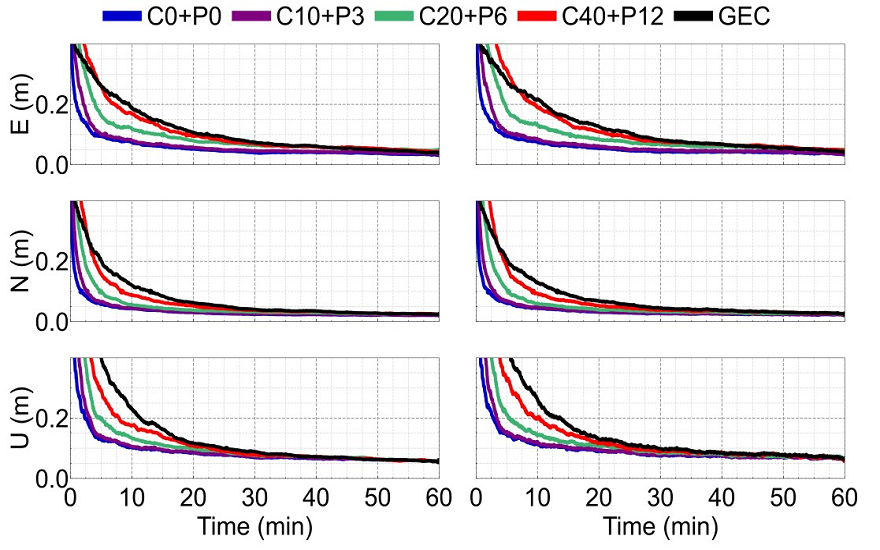
90th percentile lines of the static (left) and kinematic PPP without (black lines) and with LEO augmentation (other colored lines) under various settings for uncalibrated LEO satellite code biases (Image by YE et al.)
