
Newsroom


The iconic redwood tree (genus Sequoia) was widely distributed across the Northern Hemisphere during the Cenozoic. However, the living species are now confined to a narrow strip along the west coast of the United States. The understanding of its biogeographic history remains limited due to relatively scarce fossil records in certain regions, especially in East Asia.
In a study published in Journal of Palaeogeography, researchers from the Xishuangbanna Tropical Botanical Garden (XTBG) of the Chinese Academy of Sciences and their collaborators reported a new Sequoia fossil record from the Late Palaeogene of southwestern China, providing crucial evidence to decode the climatic and biogeographic history of this important genus.
The fossil leaves were unearthed in Jianshui County, Yunnan Province, and were dated from the Late Eocene-Early Oligocene (approximately 34-30 million years ago), They were identified as Sequoia maguanensis through morphological and cuticular analysis.
Sequoia maguanensis found in the Miandian Basin showed a significant similarity to the specimens from nearby basins. The characteristic features included the alternating arrangement of leaves with decurrent bases, straight epidermal cell walls, and stomata encircled by four cells.
"This discovery not only enriches the fossil record of Sequoia in East Asia but also provides direct evidence for its distribution in this region during a critical transitional period of global cooling," said LI Shufeng from XTBG, one corresponding author of this study.
To find out the historical distribution of Sequoia, researchers applied species distribution modeling (MaxEnt). Based on climate data from the current habitat of the sole living species, Sequoia sempervirens, along with global fossil records, they reconstructed the genus’s most suitable potential habitats from the Palaeocene to the Pliocene.
Sequoia thrived in warm and humid conditions. As global temperatures declined from the Eocene to the Pliocene, its suitable habitats progressively shifted southward and contracted toward lower latitudes. Sequoia originated in East Asia during the Early Cretaceous, later dispersing to North America via the Bering Land Bridge. During the warmer Palaeocene, its range expanded to Greenland and Svalbard, reaching Western Europe by the Eocene.
Furthermore, the disappearance of Sequoia from southwestern China, including Yunnan Province, was attributed to the combined effects of global cooling, the intensification of the East Asian winter monsoon, and the genus's own long-term morphological stasis, which limited its ability to adapt to increasingly arid conditions.
"Our study clearly illustrates the origin, dispersal, and climate-driven response patterns of Sequoia, offering an important case for understanding the evolution of Northern Hemisphere flora," said LI.
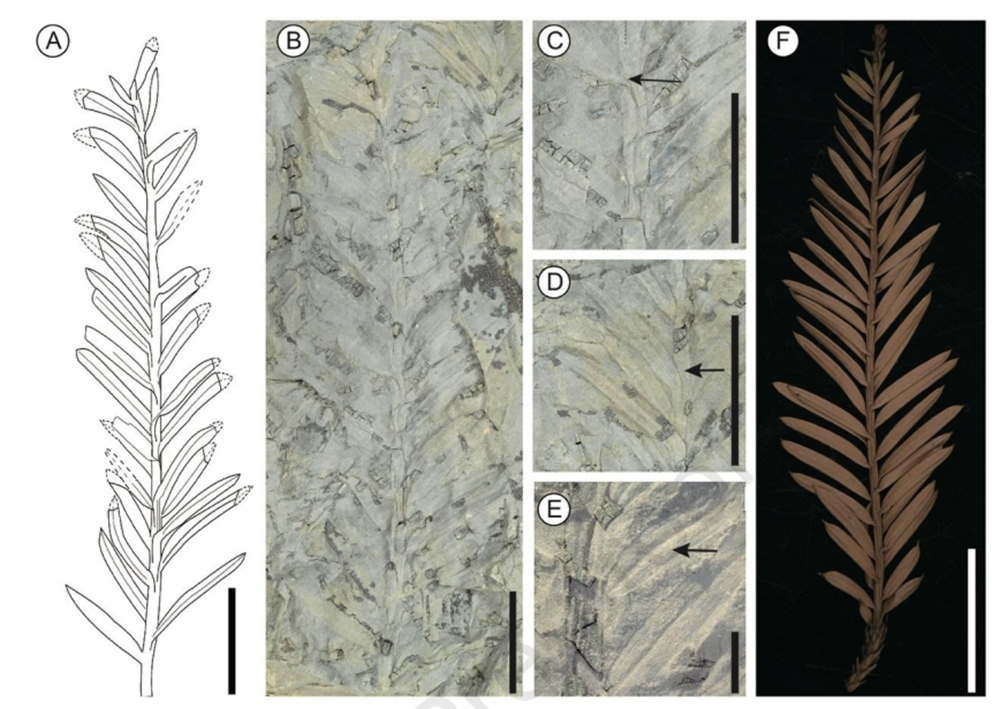
Fossil leaves of Sequoia maguanensis and living Sequoia sempervirens. (Image by YANG Rendan)
