Newsroom


An international team of experts led by Profs. MA Keping and LIU Xiaojuan from the Institute of Botany of the Chinese Academy of Sciences (IBCAS) has synthesized three decades of global forest biodiversity experiments. Their study provides ecological insights and shows that tree species diversity is a fundamental driver of ecosystem integrity.
Their study was published in Nature Reviews Biodiversity on January 2.
The widespread destruction of forests and loss of tree species has raised concerns about the negative impact on ecosystem services and human well-being. Forests are the most complex and species-rich terrestrial ecosystems, contributing more to global ecological processes, such as carbon storage and climate buffering, than any other ecosystem. The 2030 targets of the Kunming-Montreal Global Biodiversity Framework explicitly emphasize the urgent need to protect and restore forest biodiversity and ecosystem integrity. What scientific evidence supports the relationship between biodiversity and ecosystem integrity?
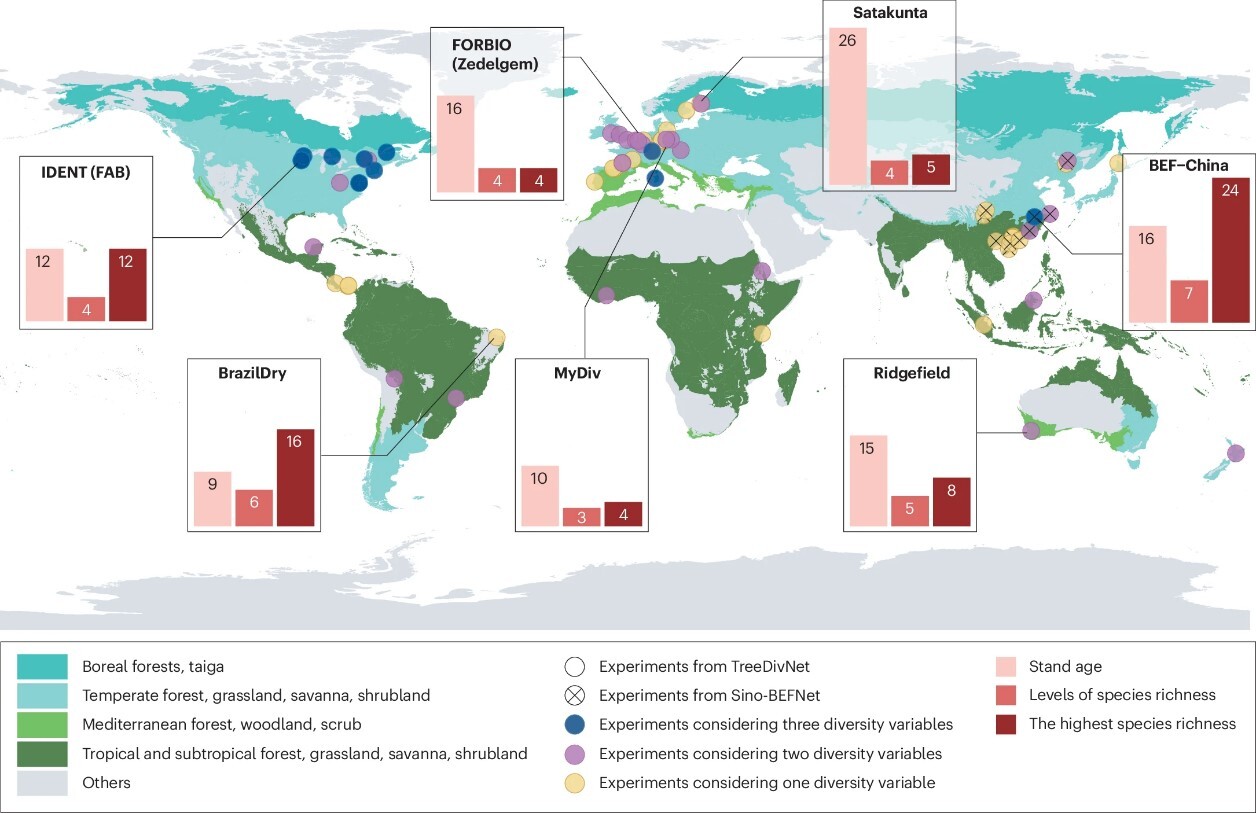
Over the past three decades, scientists have planted experimental plots with varying numbers of tree species to study the relationship between species richness and forest function. They found that the loss of tree species reduces forest productivity and many other ecosystem functions. These findings complement those from observational studies in forests around the globe.
Forest biodiversity experiments emerged in the 1990s, following earlier studies of herbaceous plant communities. Since then, the field has expanded rapidly, with 45 large-scale forest biodiversity experiments now established worldwide.
This work underscores the significance of experimental research in elucidating the causal relationship between tree species richness (biodiversity) and ecosystem functions (integrity)—a relationship that is extremely difficult to discern through observation alone.
Experimental evidence shows that the positive effects of tree diversity arise from multiple ecosystem functions and can be explained by mechanisms such as resource partitioning and facilitation between tree species. These effects are also due to high diversity of other organisms, such as insects, fungi, and microbes.
Findings from the longest-running experiments suggest that these positive effects strengthen over time. Results from natural forests and plantations indicate that these effects will likely persist in the long term.
Integrating insights from experimental and observational research, this study clarifies the multifaceted relationship between biodiversity and ecosystem functioning/integrity and its underlying mechanisms. These findings are intended to guide forest management and climate mitigation efforts by providing a scientific foundation for ecological restoration and forest management.