
Newsroom


Coronary angiography primarily reveals luminal stenosis, whereas intravascular ultrasound (IVUS) advances a miniature ultrasound transducer into the vessel to assess the lumen, vessel wall, plaque, calcification, and stent apposition or expansion, earning it the reputation as the "third eye" of coronary intervention. Conventional single-frequency IVUS, however, cannot fully balance resolution and penetration depth.
On June 2, the ultra-high-definition dual-frequency IVUS imaging system and catheter developed by Professor MA Teng's team at the Shenzhen Institute of Advanced Technology (SIAT) of the Chinese Academy of Sciences, in collaboration with the National Innovation Center for Advanced Medical Devices and Shenzhen Vista Vision Medical Technology Co., Ltd. , received approval for market entry through the National Medical Products Administration (NMPA) Special Review Procedure for Innovative Medical Devices, earning a Class III medical device registration certificate.
The system integrates 60 MHz and 90 MHz transducers in a single intravascular catheter. The 60 MHz channel offers broader visualization of vessel morphology, while the 90 MHz channel captures fine structural details.This dual-frequency design sharpens that third eye even further.
Through ultra-high-frequency transducer design, single-crystal composite materials, precise poling, meticulous packaging, and automatic image registration, a single pullback generates complementary views on the same screen. The 90 MHz channel achieves an axial resolution of approximately 15 μm, enabling visualization of thin fibrous caps, microcalcifications, and stent apposition.
Built on SIAT's expertise in scientific instrumentation, precision electromechanical control, and AI algorithms, the system supports high-speed pullback imaging, computer-aided lesion assessment, and three-dimensional stent reconstruction, improving workflow efficiency and image interpretation in catheterization laboratories.
To translate the technology from laboratory prototype to stable production, clinical use, and regulatory approval, the team established an innovation consortium. SIAT led the original research, the innovation center coordinated clinical-trial design and translation, and Vista Vision Medical Technology Co., Ltd. handled engineering development, GMP pilot production, and regulatory submission. This coordinated approach enabled the system to advance from concept to Class III approval within five years.
The approval represents a significant step from scientific-instrument innovation to clinically valuable medical devices. The team will continue to support precision interventional diagnosis and therapy while contributing to China’s independent innovation in high-end medical devices.
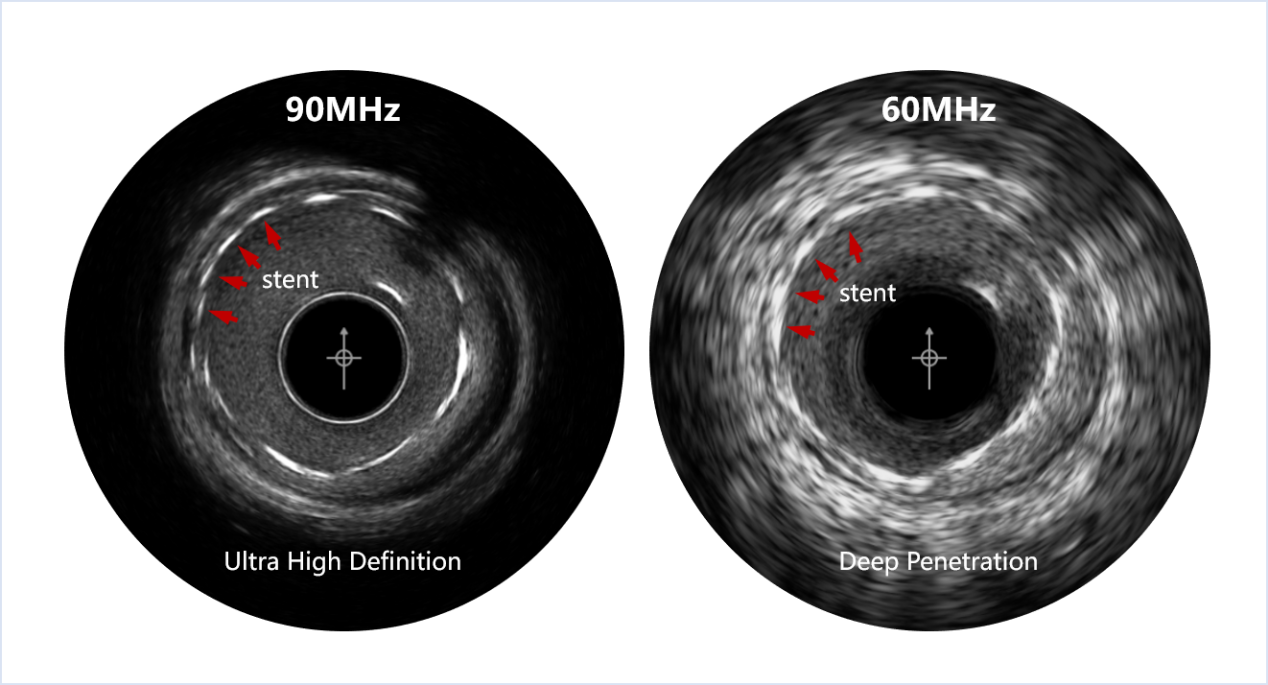
Ultra-high-definition dual-frequency IVUS: in vivo imaging after coronary stent implantation. (Image by SIAT)
