
2024


A research group led by Prof. SHENG Zhigao from Hefei Institutes of Physical Science of the Chinese Academy of Sciences has discovered the disappearance of nonreciprocal second harmonic generation (SHG) in MnPSe₃ when integrated into a two-dimensional (2D) antiferromagnetic MnPSe₃/graphene heterojunction.
The research, published in Nano Letters, highlights the role of interfacial magnon-plasmon coupling in this phenomenon.
2D van der Waals magnetic/non-magnetic heterojunctions hold significant promise for spintronic devices. Achieving desired functionalities in these systems depends on the interfacial proximity effect, which is crucial for their performance. However, detecting this effect in 2D antiferromagnetic/non-magnetic heterojunctions presents substantial challenges due to the small size and weak signals associated with these structures.
In this study, the team used a home-made SHG system to observe that the nonreciprocal SHG of MnPSe₃ disappeared when it was in contact with graphene, in contrast to the behavior observed in the antiferromagnetic MnPSe₃ layer alone. This change indicates the presence of interfacial coupling interaction or proximity effect.
To explore this interaction further, the researchers incorporated a hexagonal boron nitride (h-BN) layer between MnPSe₃ and graphene to isolate the interfacial interactions. Their experiments revealed that the range of interfacial coupling extended beyond 40 nm, significantly surpassing the typical range of a few nanometers observed in proximity effects.
Moreover, the team found that the strength of this coupling weakened as the band gap of the underlayer material increased, providing a way to tune the nonlinear SHG response. Through symmetry analysis, first-principles calculations, and comparisons with previous studies, the researchers concluded that the disappearance of the nonreciprocal SHG signal was attributed to the coupling between the surface plasmons of graphene and the magnons of MnPSe₃.
"This discovery paves the way for manipulating the nonlinear optical properties of 2D heterojunctions and developing multifunctional, tunable 2D layered nonlinear optical devices," said Prof. SHENG Zhigao.
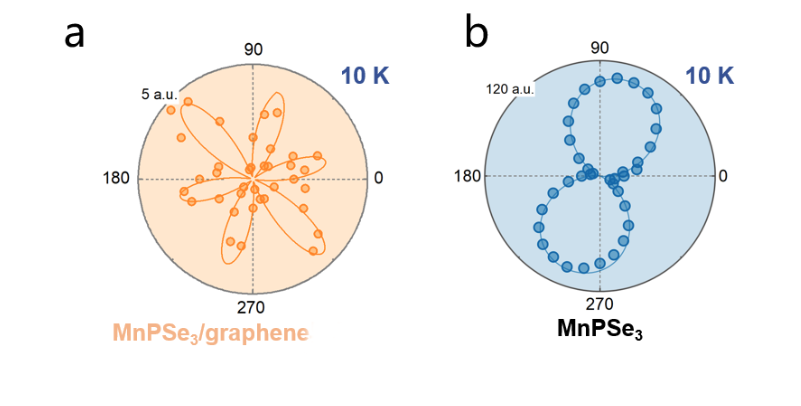
SHG polar plots of MnPSe3/graphene heterojunction (a) and MnPSe3 layer alone (b). (Image by LI Bolin)
