2024


Predators in ecosystems affect prey through direct (e.g., predation) and indirect (e.g., fear responses) ways. Prolonged exposure to predator stress causes animals to exhibit fear-like behavior, which is related to brain hormone levels. Honeybees can alter brain biogenic amine levels in response to stress stimuli, leading to changes in neural responses and behaviors.
In a study published in Journal of Animal Ecology, researchers from Xishuangbannna Tropical Botanical Garden (XTBG) of the Chinese Academy of Sciences and the University of California, San Diego, showed that fear responses of honeybees to predators are mediated by dopamine, and these responses not only increase the alertness of honeybees but also affect their cognitive abilities.
Researchers observed that honeybees showed changes in behavior when faced with simulated predator threats, including increased alertness and reduced foraging behavior. Meanwhile, through neurobiological techniques, they analyzed the role of dopamine which may affect multiple neural pathways and processes in this process.
When encountering hornets, honeybees exhibited fear-like behavior, which was manifested by a reduction in the time spent near the hornets and fleeing at a faster speed. However, after 24 hours of hornet stress, honeybees showed defensive clustering behavior, and there was a decrease in dopamine levels in their brains.
Moreover, researchers discovered that prolonged exposure to predators also reduced honeybees' olfactory sensitivity to scents and mechanical sensitivity to airflow, leading to impaired olfactory associated learning ability. Artificially increasing the dopamine levels in honeybees' brains alleviated their fear of hornets and to some extent restored honeybees' olfactory sensitivity and learning ability.
"We provide the first demonstration that exposure to hornets can harm honeybees' antennal functioning, reducing the ability of the antennae to detect odors. This reduction likely contributes to the significant decrease in learning ability in these honeybees," said DONG Shihao, a corresponding author of the study.
This study suggested that dopamine plays a role in regulating insect fear-like behavior and is closely related to the declines in olfaction and cognition. It also indicates that fear-like behavior, such as group clustering and reduced movement in individual bees, can spread from individuals to the entire group, similar to fear transmission in other animals.
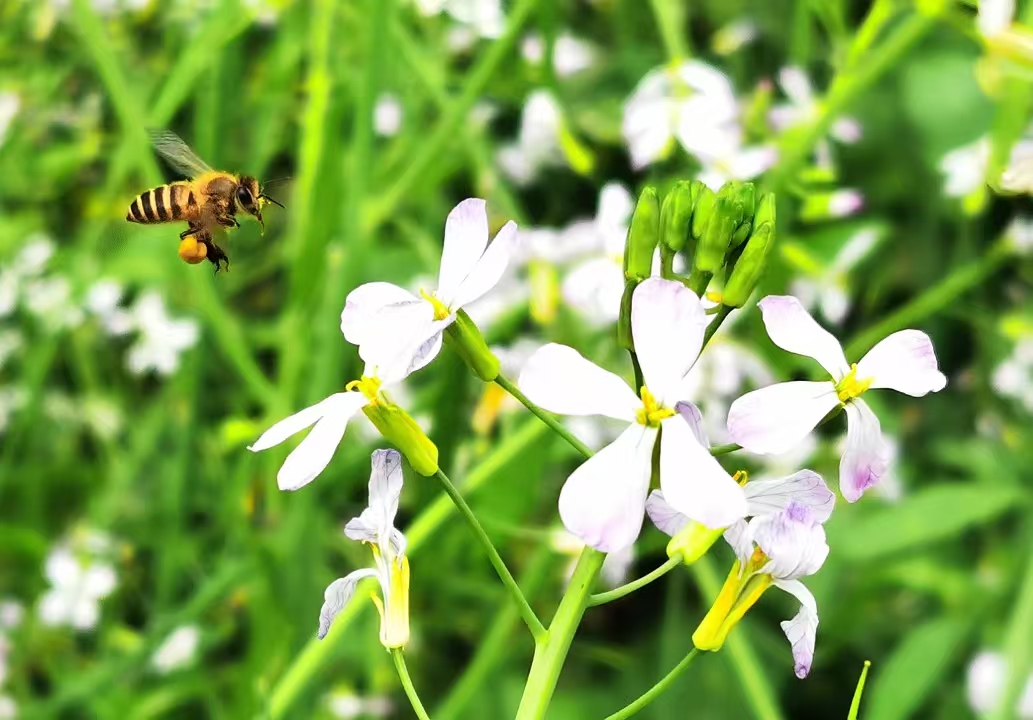
Honeybee on flowers. (Image by DONG Shihao)