
2024


The dorsal root ganglion (DRG) is a cluster of cell bodies located in the dorsal root of the spinal cord, housing sensory neurons. It plays critical roles in detecting external stimuli such as mechanical forces, temperature, itch, and noxious signals like pain, and is a potential therapeutic target for treating chronic pain, particularly neuropathic pain.
A collaborative research team from the Institute of Biophysics (IBP) at the Chinese Academy of Sciences, Beijing Normal University, and the Guangdong Academy of Intelligent Science and Technology, recently presented their insights into human DRG development in an article in Cell on November 12.
Utilizing multiomics sequencing technologies, particularly TF-seqFISH, a single-cell spatial transcriptomics technology approach developed by WANG Xiaoqun's team at IBP, the researchers constructed the spatiotemporal transcriptomics atlas of human embryonic DRG development during early to mid-pregnancy.
For the first time, they revealed the dynamic changes in cellular diversification and spatial organization within human DRG during critical developmental stages.
By tracing the differentiation trajectories of early neural crest cell (NCC) lineages, the researchers elucidated the external signaling pathways and internal transcription factors that regulate the cell type differentiation and specification.
Mimicking the programmed activation of signaling in vivo, they establish functional human DRG organoids, which recapitulate differentiation progression from pluripotent stem cells to NCCs, sensory neuron progenitors, and mature sensory neurons, including the human enriched NTRK1+/NTRK3+/DCC+ nociceptor subtype in vivo.
The researchers also incorporated the DRG organoid model and validated the critical roles of various transcription factors in regulating sensory neuron specification. Their study indicated the value of organoids in studying human sensory system development and function.
This research provides valuable resource on studying human embryonic DRG development and has established a robust culture system for generating human DRG organoids. It offers critical foundations for further investigations on exploring sensory system development and screening drug targets to treat sensory nervous system disorders, such as chronic pain and itch, according to the researchers.
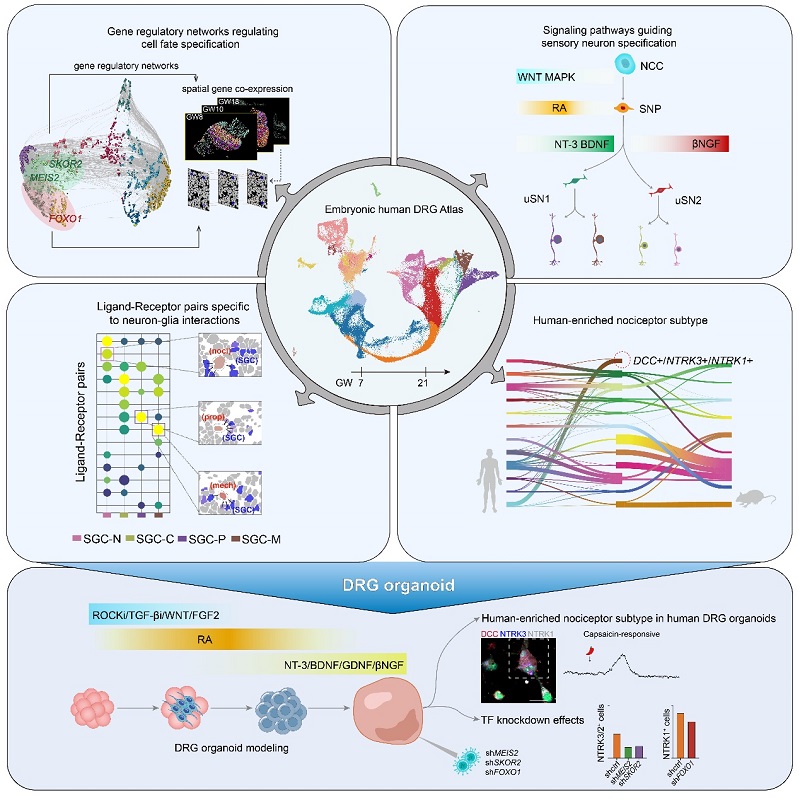
Spatiotemporal development mechanisms of human dorsal root ganglia and organoid modeling (Image by WANG Xiaoqun's group)
