
2024


Recently, a collaboration between the Institute of Biophysics (IBP) of the Chinese Academy of Sciences and the National Institute of Biological Sciences (NIBS), Beijing, led to the discovery of a novel killer gene, tdk1, in the fission yeast (Schizosaccharomyces pombe). This research revealed the molecular and structural mechanisms by which its protein product TDK1 controls cell survival.
Two related papers were published in PNAS on November 1, 2024.
Killer meiotic drivers (KMDs) are a type of selfish genetic element that can kill gametes lacking the gene during meiosis, thereby increasing its chances of being passed on to offspring. Killer genes typically require two components, a toxin and an antidote, to achieve selective killing.
The study identified tdk1 as a novel killer gene in Schizosaccharomyces pombe. It expresses a single protein, TDK1, which, through structural changes, can serve as both toxin and antidote, representing a new mechanism.
Schizosaccharomyces pombe primarily reproduces asexually as haploid cells but can undergo sexual reproduction upon starvation. During sexual reproduction, haploid cells of opposite mating types fuse to form diploids, which then undergo meiosis to produce four haploid spores.
During both vegetative growth and meiosis, the TDK1 protein forms a non-toxic tetrameric structure. However, in spores, the region near the carboxyl terminus of TDK1 shifts into a toxic hexameric conformation, which binds to the acetylated histone reader Bdf1.
The toxic TDK1 can also form supramolecular assemblies that prevent chromosome segregation during mitosis, killing spores that lack the tdk1 gene. In spores carrying the tdk1 gene, newly synthesized TDK1 disassembles these toxic supramolecular assemblies during germination, functioning as an antidote to protect carriers.
This study has identified a new type of selfish genetic element and revealed the molecular and structural mechanism by which a single protein product utilizes structural duality to function as both toxin and antidote. This provides new insights into the evolutionary study of KMDs.
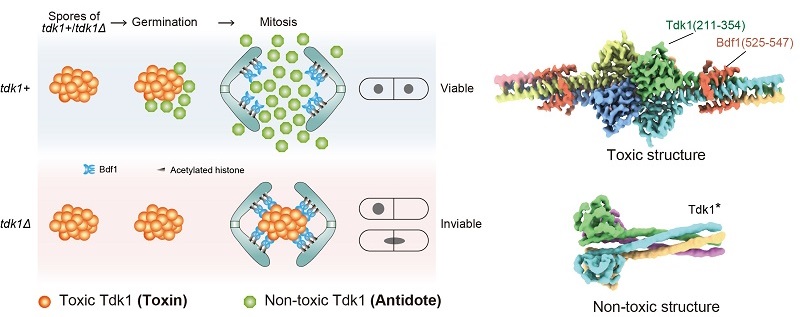
The left cartoon model illustrates how Tdk1 as both a toxin and an antidote controls mitosis of fission yeast spores. The right panel shows that the toxic and non-toxic structures of Tkd1. (Image by YE Keqiong's group)
