2024


The restoration of the clear water state in the eutrophic shallow lake is a complex and challenging process. Some restorations involve completely or partially removing fish, in combination with the recovery of submerged macrophytes, to bring the aquatic ecosystem back to a clear water state.
However, due to the abundance of food resources and the vacancy of ecological niches left by fish reduction in the early stages of ecological restoration, the abundance of benthic fish may increase sharply in the early stages of clear water state recovery. This could severely weaken the water clearing effect of submerged macrophytes and even lead to the failure of ecological restoration. Therefore, understanding the interaction between benthic fish and submerged macrophytes is crucial for the recovery and maintenance of the clear water state.
Recently, a research group led by Prof. CAO Te from the Institute of Hydrobiology (IHB) of the Chinese Academy of Sciences demonstrated that benthic fish may exert diametrically opposed effects on water quality in the presence and absence of submerged macrophytes. This study was published in Water Reaserch.
Researchers first conducted an in-situ enclosure experiment to explore the water clearing effect of submerged macrophytes with different coverage (0-40%) before and after the removal of benthic fish. They found that an increase in the coverage of submerged macrophytes significantly improved the water quality. Without external nutrient input and fish disturbance, submerged macrophytes with a coverage of 40% or more can maintain the clear water state of shallow lakes. However, the presence of benthic fish severely weakens the water clearing effect of submerged macrophytes.
In addition, researchers investigated the impact of benthic fish of different densities (0-20 g/m3) on water quality with and without submerged macrophytes. They found that the presence or absence of submerged macrophytes may reverse the role of benthic fish in freshwater ecosystems. When submerged plants are present, benthic fish always lead to water quality deterioration, and when they are absent, low-density benthic fish (< 10 g/m3) may inhibit the development of phytoplankton by directly feeding or disturbing sediments to increase turbidity or through other mechanisms, hindering/delaying the eutrophication process of the water body. However, this positive effect of benthic fish may reverse again at higher densities where high-density benthic fish can further deteriorate water quality.
This study emphasize the need to consider the comprehensive regulation of submerged macrophytes and fish communities during the aquatic ecological restoration process to achieve sustainable management of lake ecosystems. It underscores the importance of understanding ecosystem interactions and provides guidance for the management of shallow lakes.
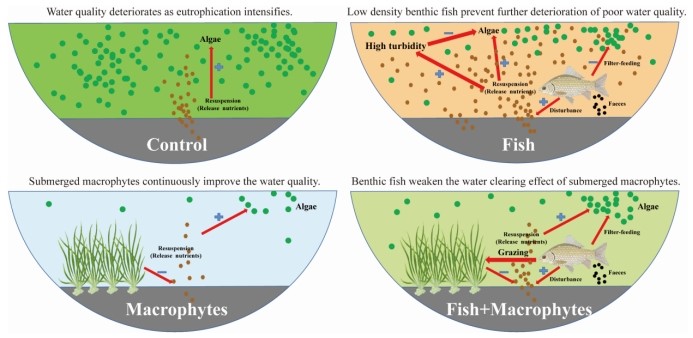
The impact of submerged macrophytes and benthic fish on eutrophic shallow lakes. (Image by IHB)