
2024


The Large High Altitude Air Shower Observatory (LHAASO) has realized daily monitoring of the interplanetary magnetic field between the Earth and the Sun for the first time. This was accomplished by precisely measuring the subtle changes in the shadow formed by solar occlusion of galactic cosmic rays due to solar activity.
The findings capture changes in the interplanetary magnetic field 3.3 days earlier than observations made by satellites near the Earth's orbit. It challenges traditional models of the interplanetary magnetic field, injecting vitality into research and monitoring of the space environment.
This study was published in The Innovation. It was conducted by the LHAASO collaboration led by the Institute of High Energy Physics (IHEP) of the Chinese Academy of Sciences. Dr. NAN Yuncheng and Prof. CHEN Songzhan from IHEP, and Prof. FENG Cunfeng from Shandong University, are the corresponding authors of the study.
With the increasing use of electronic and space equipment, the impact of solar activity on humanity is gradually being amplified. Consequently, monitoring solar activity and forecasting space weather between the Earth and the Sun have become important areas of scientific research.
However, within the vast interplanetary space between the Earth and the Sun, monitoring methods have always been a weak link in the overall monitoring system, struggling to provide a complete and instantaneous picture of changes in the interplanetary magnetic field. Clearly, this information is essential for effective monitoring and forecasting of the space environment.
Galactic cosmic rays are primarily composed of positively charged high-energy particles that collide with Earth from all directions. The Sun shields these high-energy particles and creates a shadow known as the "Sun shadow." Cosmic rays are deflected by the varying magnetic field in the space between the Earth and the Sun. Therefore, the movement of the Sun shadow can trace the deflection of cosmic rays, and these cosmic rays act as probes that can "diagnose" the strength and changes in the magnetic field.
Previously, while cosmic ray detection arrays could observe the Sun shadow, limitations in the sensitivity of these arrays prevented them from accurately measuring the shadow using data from the same day. However, LHAASO, with its exceptional high sensitivity, has achieved real-time daily observations of this phenomenon for the first time.
Researchers successfully measured the intensity and variations of the interplanetary magnetic field on a daily basis from March to October 2021, using the information on the daily movement of the Sun shadow's position. They found that these measurements are 3.31 ± 0.12 days ahead of those obtained by spacecraft near Earth, providing a new method for long-term monitoring of the interplanetary magnetic field and its changes.
This finding advanced the understanding of the interplanetary magnetic field over large distances between the Earth and the Sun. Furthermore, the 3.31-day lead time challenges traditional models of the interplanetary magnetic field, such as the Parker model, which predicted a lead time of only 2.06 ± 0.04 days.
The LHAASO collaboration has achieved significant results in various fields of physics based on data from the LHAASO experiment, and this discovery marks its first important achievement in the application of cosmic ray research. LHAASO is located on Haizi Mountain at an altitude of 4410 meters in Daocheng County, southwest China's Sichuan Province. It is one of the leading cosmic ray detection devices in the world.
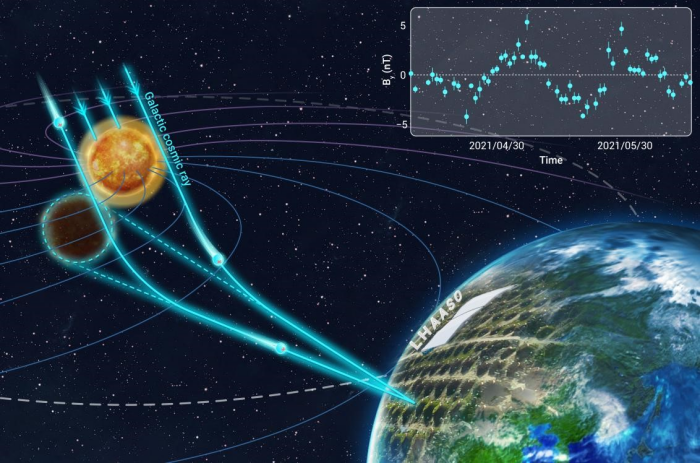
LHAASO utilizes the cosmic ray Sun shadow to measure the interplanetary magnetic field between the Earth and the Sun, illustrating the intensity of the interplanetary magnetic field near Earth and its changes over time, with measurements captured 3.3 days in advance. (Image by IHEP)
