2024


Recently, a joint research group from China achieved the first observation of intrinsic magnetic structures in a kagome lattice by using highly sensitive magnetic force microscopy (MFM) system of the Steady High Magnetic Field Facility (SHMFF) as well as electron paramagnetic resonance spectroscopy and micromagnetic simulations.
The findings were published in Advanced Science on August 19.
The behavior of materials is largely determined by the interaction between their internal electrons and the lattice structure. Kagome lattices, characterized by features such as Dirac points and flat bands, exhibit remarkable phenomena like topological magnetism and unconventional superconductivity.
These lattices hold promise for understanding high-temperature superconductivity and have potential applications in quantum computing. However, the intrinsic spin patterns governed by them remain an open question.
Led by Prof. LU Qingyou at the Hefei Institutes of Physical Science of the Chinese Academy of Sciences, in collaboration with Prof. XIONG Yimin from Anhui University, the researchers discovered a new lattice-modulated magnetic array in the binary kagome Fe₃Sn₂ single crystal.
This array formed a unique broken hexagonal structure due to the competition between hexagonal lattice symmetry and uniaxial magnetic anisotropy. Hall transport measurements further confirmed the presence of topologically broken spin configurations within the material.
Variable-temperature experiments revealed that the magnetic reconstruction in Fe₃Sn₂ single crystals occurred through a second-order or weak first-order phase transition, revising earlier assumptions of a first-order transition.
Meanwhile, this discovery also redefined the low-temperature magnetic ground state as an in-plane ferromagnetic state, contradicting previous reports of a spin-glass state.
Based on these results, the team developed a new magnetic phase diagram for Fe₃Sn₂.
Quantitative MFM data showed that significant out-of-plane magnetic components persist at low temperatures. Using the Kane-Mele model, the team explained the opening of the Dirac gap at low temperatures, hence dismissing prior hypotheses about the presence of skyrmions under these conditions.
This breakthrough provides new insights for exploring topological magnetic structures and developing future technologies in quantum computing and high-temperature superconductivity, according to the team.
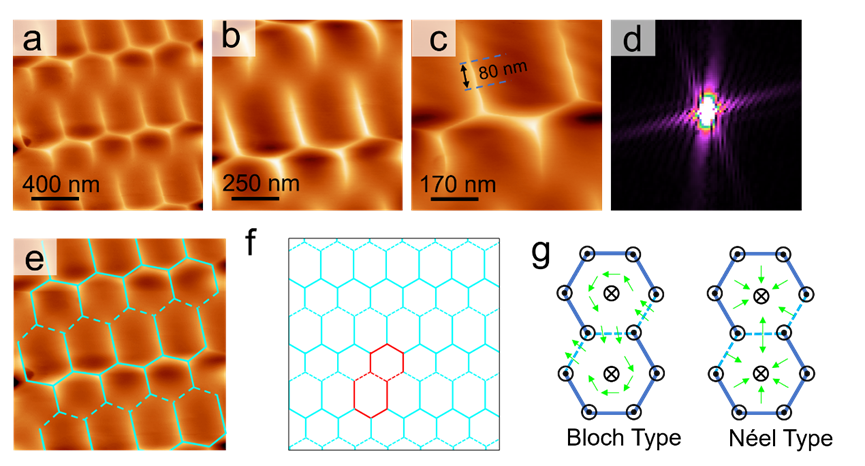
Utilizing the self-developed highly sensitive MFM, researchers realized the first direct observation of intrinsic magnetic structures in a kagome lattice and discovered a new type of topologically broken magnetic array structure. (Image by FENG Qiyuan)