
2024


In a study published in Physical Review A, scientists at the Institute of Modern Physics (IMP) of the Chinese Academy of Sciences (CAS) and their collaborators reported the nonradiative double-electron capture (NRDC) in collisions of 95–197 MeV/u bare Xe54+ ions with Kr and Xe atoms.
Ion-atom collisions represent the evolution of quantum many-body systems determined by the electromagnetic interaction. Electron capture is a basic process in ion-atom collisions, and plays an important role in various branches of physics, such as plasma physics and astrophysics.
Highly charged high-Z ions carry strong Coulomb field and exhibit extremely strong ability of electron capture. In fast collisions of these high-Z ions with heavy atomic targets, relativistic effects and quantum electrodynamic (QED) effects become significant.
While the nonradiative electron capture (NRC) is the dominant charge-exchange process in these collisions, the NRDC process also plays a significant role. However, it remains challenging to well understand the fundamental physics involved in the NRDC process.
"To investigate NRC and NRDC processes, we performed an X-ray spectroscopy experiment by employing the heavy ion cooling storage ring with an internal gas-jet target. High-precision measurements of characteristic X-ray emissions can not only provide insights into atomic fine-structure levels and electron correlation effects in heavy few-electron systems, but also serve as a test of the theoretical models," said Dr. YANG Bian from IMP and the first author of this study.
The experiment was carried out at the Heavy Ion Research Facility at Lanzhou–Cooling Storage Ring (HIRFL-CSR). Scientists conducted X-ray measurements associated with the NRC and NRDC in fast collisions of bare Xe54+ ions with Kr and Xe gaseous atoms.
The results for the Kr target showed that the NRDC event can be regarded as two uncorrelated single-electron capture processes. However, in the symmetric Xe54+ + Xe collisions, the results indicated that the NRDC process cannot be regarded as two independent one-electron capture events and the resonant electron transfer plays an important role therein.
These findings could be used to reveal the excited state formation mechanism of few-electron heavy ions, and offer a new perspective for studies on relativistic effects and QED effects under extreme conditions of strong field perturbations.
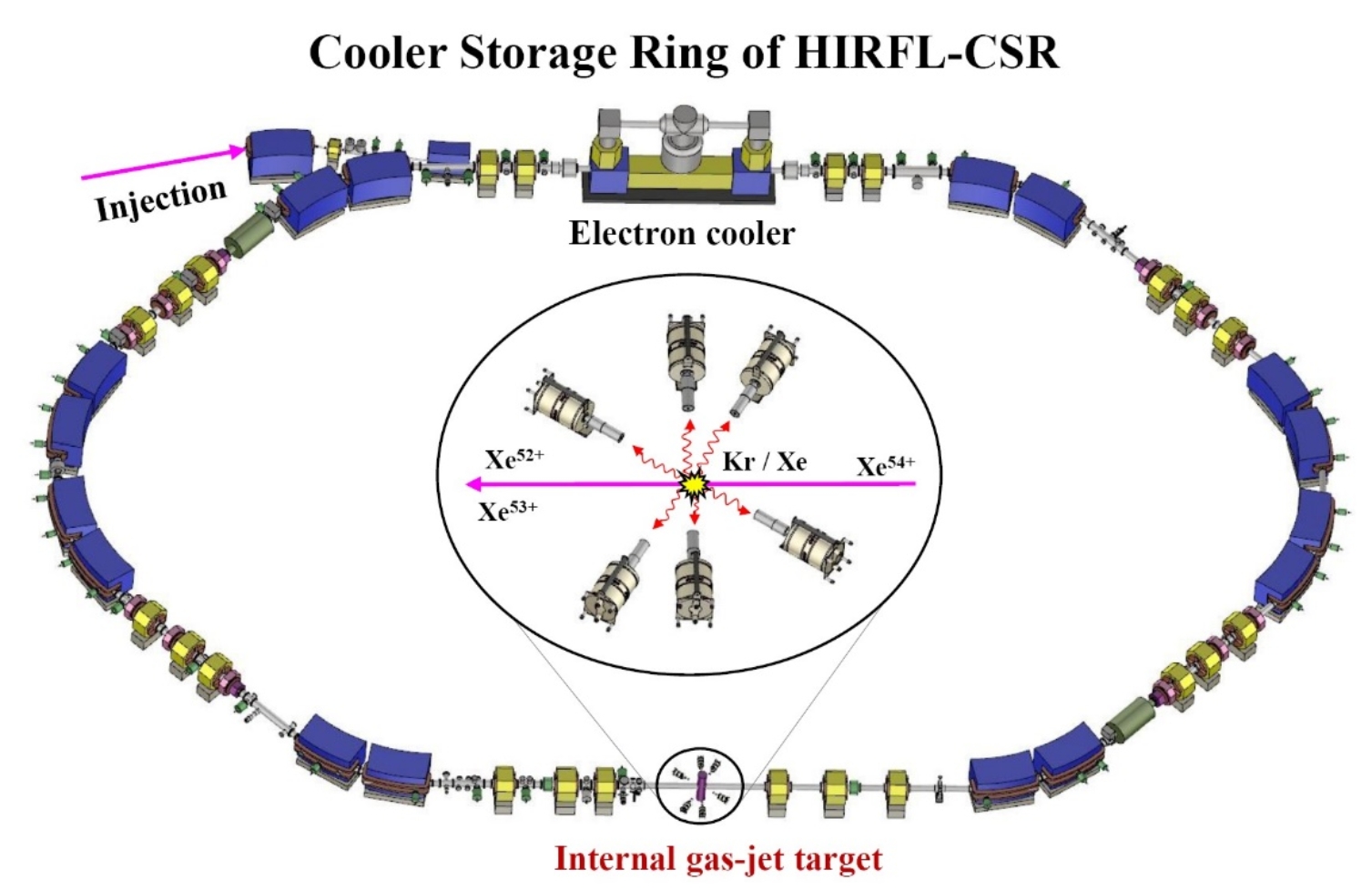
Schematic of the experimental arrangement of the X-ray measurement in fast collisions of highly charged heavy ions with gaseous targets at HIRFL-CSR. (Image by IMP)
