2024


An international team led by Prof. ZHANG Jujia from the Yunnan Observatories of the Chinese Academy of Sciences successfully captured the spectacular moment when the explosion shock wave of supernova (SN) 2024ggi broke through the surrounding dense circumstellar material (CSM). This study, published in The Astrophysical Journal Letters, enhances the understanding of the physical mechanisms behind SN shock breakout and offers insights into unraveling the mysteries of late-stage stellar evolution and death.
Shock breakout marks the critical juncture when the shock wave reaches the stellar surface, transitioning it from an opaque to a transparent state. This signal unveils the extreme physics during a star's death throes, including shock formation, propagation, and interactions with the stellar surface and its surrounding material. In addition, it offers invaluable insights into SN explosion mechanisms, aiding in validating and refining existing theoretical models.
Typically fleeting, lasting mere seconds or minutes, shock breakout is incredibly challenging to detect. However, in cases where the explosion occurs in dense and opaque CSM, the first photons must traverse this additional material before escaping, extending the shock breakout timescale to days. This extension provides a unique window for astronomers to capture the shock breakout signal and probe its underlying physics.
The explosion of SN 2024ggi provided such an opportunity. This SN is located in the galaxy NGC 3621, about 20 million light-years from Earth.
Researchers utilized advanced astronomical facilities such as the 2.4-meter Lijiang Telescope of Yunnan Observatory, the 10-meter Very Large Telescope of the European Southern Observatory, the 3.6-meter Telescopio Nazionale Galileo in Italy, and the 6.5-meter Magellan-Baade Telescope at Las Campanas Observatory, and conducted continuous high-cadence spectral monitoring of this SN during the initial few tens of hours after the explosion.
Based on these early spectra, researchers captured the shock breakout signal, revealing the complex shock wave propagation of SN 2024ggi.
Between 13.9 and 16.2 hours post-explosion, four spectra revealed that the shocked CSM remained in a relatively low ionization state. However, just a few hours later, this material reached a significantly high ionization state, accompanied by a rapid increase in temperature and the acceleration of particles.
These observations indicated that the shock injected much energy into CSM and gradually broke through its barriers. Notably, the ionization state fluctuated within nine hours after reaching its peak, indicating that the material encountered during shock breakout was far more complex than expected by theoretical models.
Using these shock signals, researchers calculated the time and region of the shock breakout and measured the density and distribution of CSM.
The observation of SN shock breakouts offers a glimpse into the final physical processes of stellar lives, providing invaluable data for unraveling the enigmas surrounding stellar death. This study enhances the understanding of the initial stages of SN explosions and shock propagation through the asymmetric stellar surroundings, elevating the perspective on stellar evolution and SN explosion.
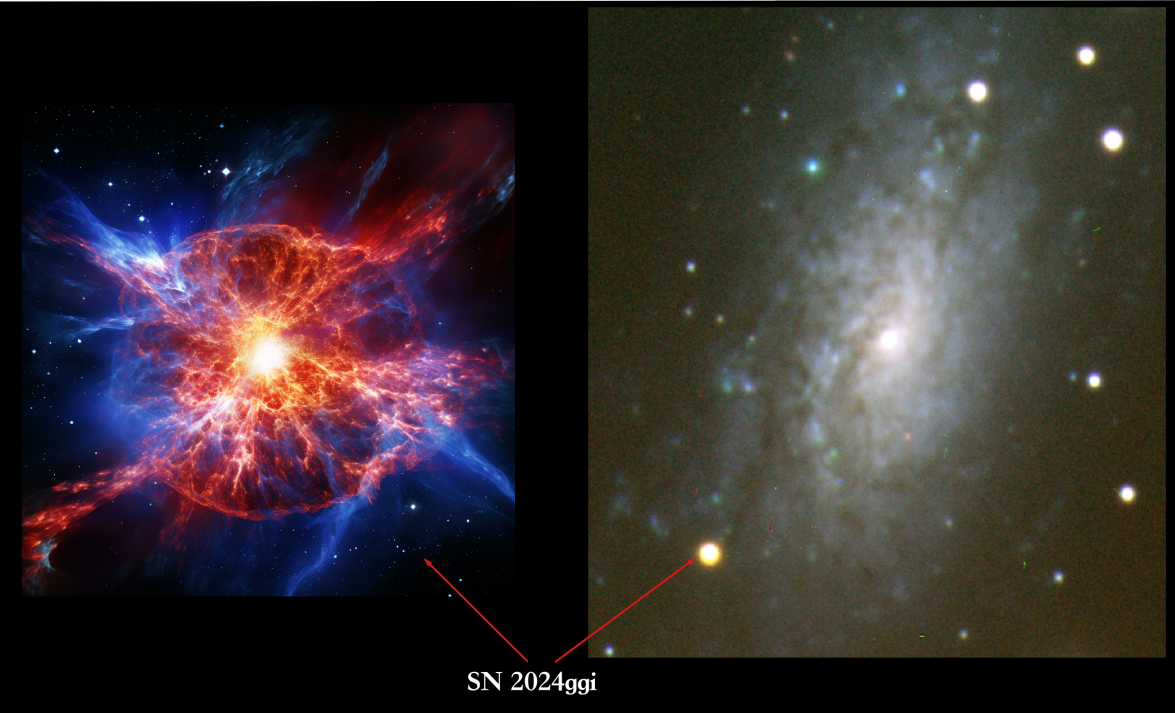
Artistic illustration of the shock breakout of SN 2024ggi (left); Observational image of SN 2024ggi and its host galaxy NGC 3621(right). (Image by Prof. ZHANG)