2024


Excessive pesticide and antibiotic use can cause neurotoxicity, endocrine disruption, and cancer. Therefore, developing affordable, convenient, and sensitive detection technology is crucial for food safety and sustainable agriculture.
Immunochromatographic assays (ICA) are promising for on-site rapid detection due to their low cost and ease of use. However, their application for detecting trace-level small molecules is limited by insufficient sensitivity and semi-quantitative results.
Recently, a research team from the Hefei Institutes of Physical Science (HFIPS) of the Chinese Academy of Sciences developed a novel competitive dual-channel color-tone change fluorescent immunochromatographic assay (CFICA), a new system that enables ultrasensitive detection of pesticide and veterinary drug residues.
In this study, researchers used polyethylenimine (PEI) self-assembly technology to prepare silica core double-layer quantum dot shell composite fluorescent labels. These labels can glow in three different colors: red, green, and blue. The green and blue fluorescent labels were used as detection probes, while the red labels were used as encapsulation probes.
"Introduction of multicolor fluorescence into the immunoassay system facilitated the development of the CFICA detection system," said WANG Shu, one of the corresponding author of the study, and a researcher from HFIPS.
The team also created a handheld fluorescence reader to conveniently measure the multicolor signals on CFICA strips quantitatively.
Tests showed that the system proved highly effective in detecting the antibiotic kanamycin (KAN) and the fungicide carbendazim (CBZ) in real samples like milk, tea, lake water, and soil, at least 100 times more sensitive than current maximum residue limits (MRLs).
Results of this study were published in Sensors and Actuators: B. Chemical.
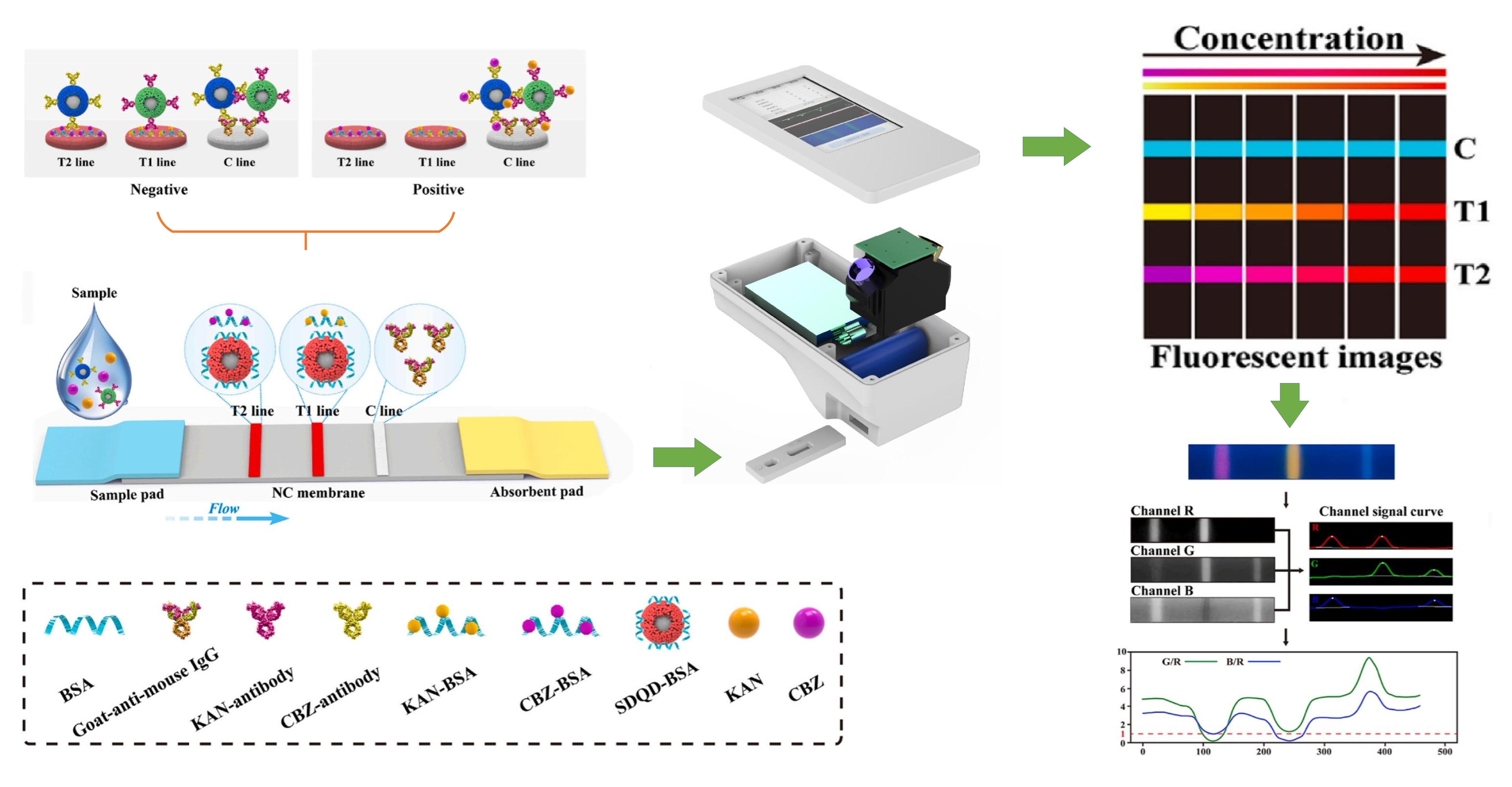
CFICA and its technical principles (Image by WANG Shu)