
2024


A research team led by Prof. YANG Huangtianfrom the Shanghai Institute of Nutrition and Health (SINH) of the Chinese Academy of Sciences, collaborating with Prof. WANG Zhinong from the Shanghai Changzheng Hospital, Naval Medical University, identified novel functions of a circular RNA (circRNA) circCHSY1 in protecting hearts against ischemia/reperfusion (I/R) injury via maintenance of mitochondrial homeostasis. The study was published online in Cardiovascular Research.
Restoration of blood supply timely after myocardial infarction is essential to save the ischemic heart. However, it is accompanied by reperfusion injury, termed myocardial I/R injury. The existing interventions available clinically are very limited.
CircRNAs form via backsplicing of exons or/and introns. During myocardial I/R injury, mitochondria play a decisive role in cell survival, highlighting the importance of maintaining mitochondrial homeostasis in protecting the heart against I/R injury. However, whether circRNAs are involved in the regulation of mitochondrial homeostasis during I/R remains unknown.
Based on the RNA-seq screening data, researchers from SINH and the collaborators identified that a circRNA circCHSY1 is upregulated during myocardial I/R injury. The higher level of circCHSY1 protects I/R hearts and cardiomyocyte through enhancement of the HO1 level, resulting in preserving mitochondrial homeostasis via targeting miR-24-3p in cardiomyocytes.
The analysis showed that the increased expression of circCHSY1 effectively protected the hearts and cardiomyocytes against I/R injury in mouse in vivo model and rat cardiomyocytes model which subjected to a glucose deprivation/reperfusion (OGD/R) injury. Overexpression of circCHSY1 maintained mitochondrial homeostasis in the cardiomyocytes and attenuated the cardiomyocyte OGD/R injury.
Through bioinformatics analysis, molecular and cellular experiments, researchers identified miR-24-3p as the binding target of circCHSY1, and found that circCHSY1 overexpression-mediated protective effects on cells and mitochondria were reversed by the miR-24-3p mimic.
The miR-24-3p downregulated the expression of heme oxygenase 1 (HO1) protein, a mitochondrial regulatory protein, via directly binding to HO1, but it was reversed by overexpression of circCHSY1 in OGD/R cardiomyocytes and myocardial I/R injury model. HO1 knockdown eliminated cardioprotective effects of circCHSY1 overexpression.
Furthermore, researchers validated the protective role of circCHSY1 in the OGD/R model of human embryonic stem cell-derived cardiomyocytes.
This study suggests that circCHSY1 might act as an endogenous protective factor, and provides novel insights into circRNA-regulated pathways against myocardial I/R injury.
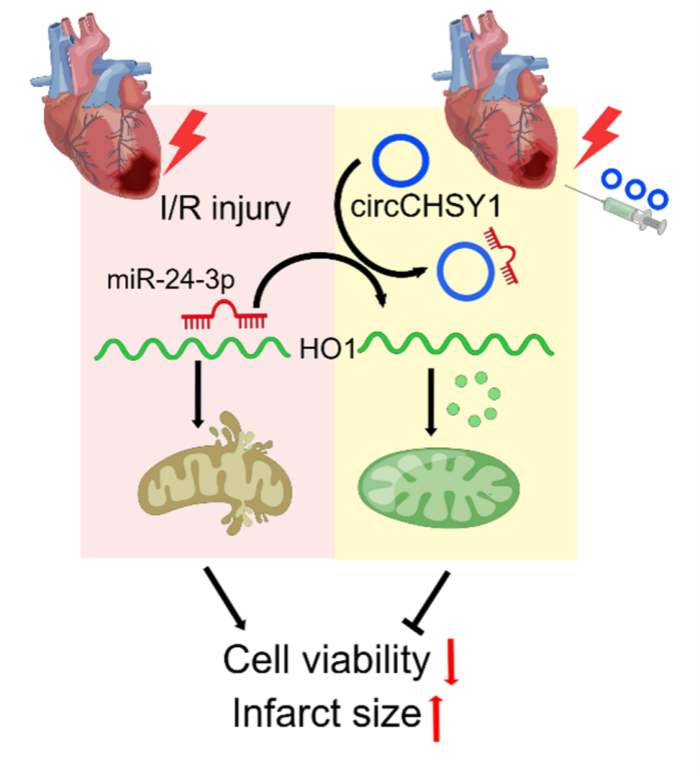
The protective effect of circCHSY1 on myocardial I/R injury. (Image by Prof. YNAG's team)
