2024


In a study published in Science Advances, a research team led by Prof. ZHANG Xinzheng from the Institute of Biophysics of the Chinese Academy of Sciences introduced a new algorithm signal-to-noise ratio iterative reconstruction method (SIRM), which purely utilized a computational method to eliminate or reduce distortions in cryo-electron microscopy (cryo-EM) three-dimensional reconstructions caused by preferred orientation problem.
Cryo-sample preparation is a major bottleneck in single-particle analysis techniques. One of the most common and challenging problems caused by cryo-sample preparation is the issue of preferred orientation.
To solve this problem, the SIRM algorithm first removes misaligned particles from datasets with orientation bias (these misaligned particles stem from the preferred orientation problem). Then, based on Fourier component signal-to-noise ratio, it performs dual-space-constrained iterative reconstruction in Fourier space and real space to correct distortions in three-dimensional reconstructions and reduce resolution anisotropy.
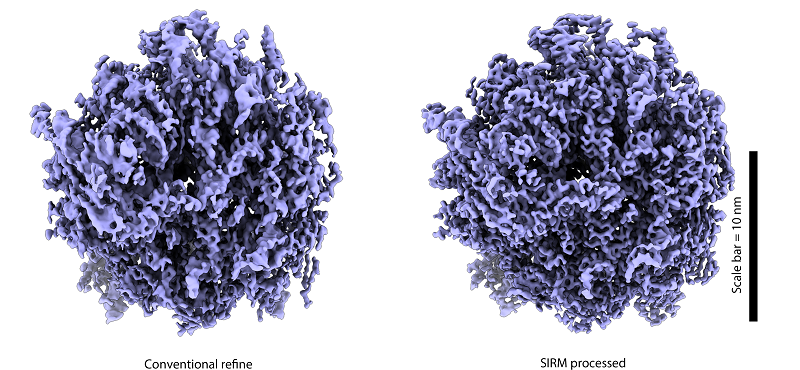
Through data analysis, researchers found that this method can further enhance the accuracy of three-dimensional reconstructions in datasets with preferred orientation, thereby improving the resolution of three-dimensional reconstructions.
Using the SIRM algorithm, the researchers processed several datasets with preferred orientation. The results showed a significant improvement in resolution in the direction of the missing region in the reconstructed images after the adoption of this new method. It did effectively restore density distortions and result in resolution enhancement.
Compared to experimental methods, SIRM relies solely on computational algorithms, offering advantages of low cost, ease of operation, and clear principles. It holds great potential in obtaining high-resolution three-dimensional structures of important protein complexes.