2024


Point-of-care testing (POCT) devices show great advantages over conventional diagnostic tests in being close to patient and providing timely diagnostic information. The global POCT market has grown remarkably over the past few decades. Distance-based devices are attracting great interest due to their simplicity, affordability, and ease of application.
Researchers at the Suzhou Institute of Biomedical Engineering and Technology (SIBET) of the Chinese Academy of Sciences have proposed a distance-based visual miRNA biosensor based on a DNA hydrogel system.
The target miRNA-initiated strand displacement amplification process will produce abundant single-stranded DNA, which are essential probes for the linking of the three-way junction scaffold of the hydrogel. The phase transition of the solution is confirmed by elastic and electrochemical techniques. A distance-based paper biosensing method is thus steup by establishing the relationship between the seepage flow distance along the strip and the initial miRNA concentration.
Due to the strand displacement amplification, the biosensor is not only simple but also highly sensitive with a detection limit down to 1 fM.
Since the three-dimensional DNA hydrogel provides abundant binding sites, the detection range is quite wide, according to the researchers.
The biosensor is shown to be highly selective, and the results of human serum analysis are consistent with standard quantitative reverse transcription-PCR.
"This approach has the advantages of convenient operation and low cost, which meets the requirements of point-of-care testing," said MIAO Peng, lead author of the study. "It is promising as a convenient tool for miRNA-related biological studies and clinical diagnosis."
The results of the study, entitled "Distance-Based Visual miRNA Biosensor with Strand Displacement Amplification-Mediated DNA Hydrogel Assembly," were published in ACS Materials Lett.
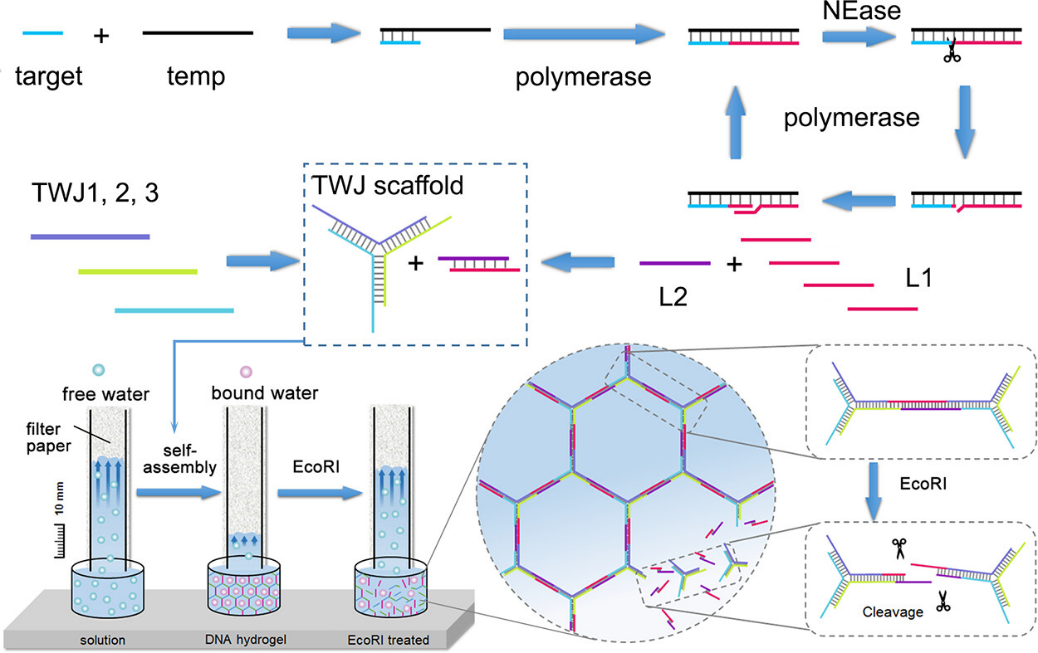
Illustration of the sensing principle of the distance-based miRNA assay. (Image by SIBET)
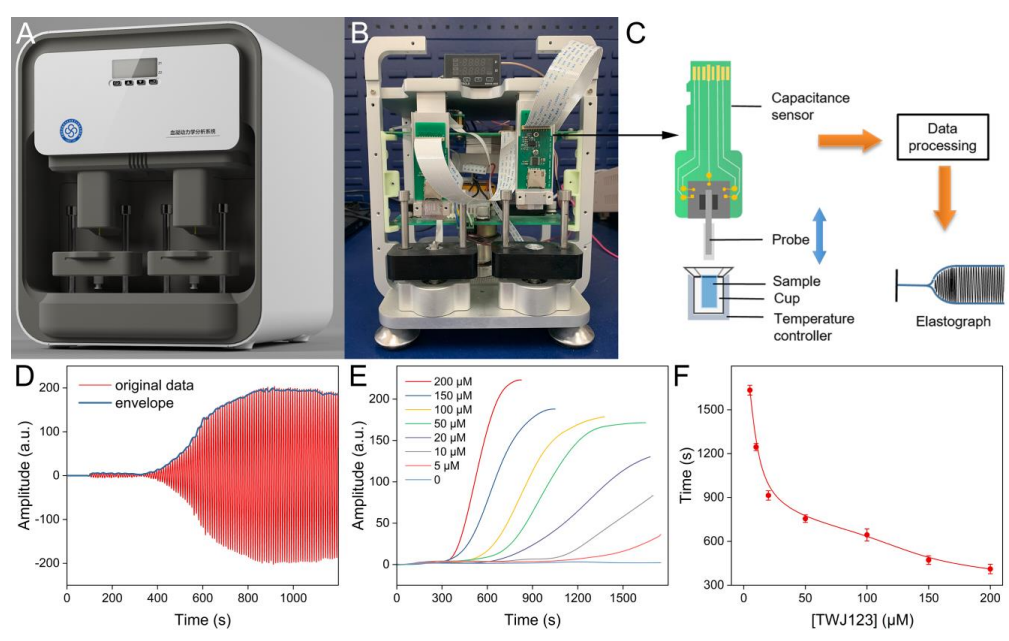
Principle of the elasticity instrument and the optimization by amplitude comparison. (Image by SIBET)
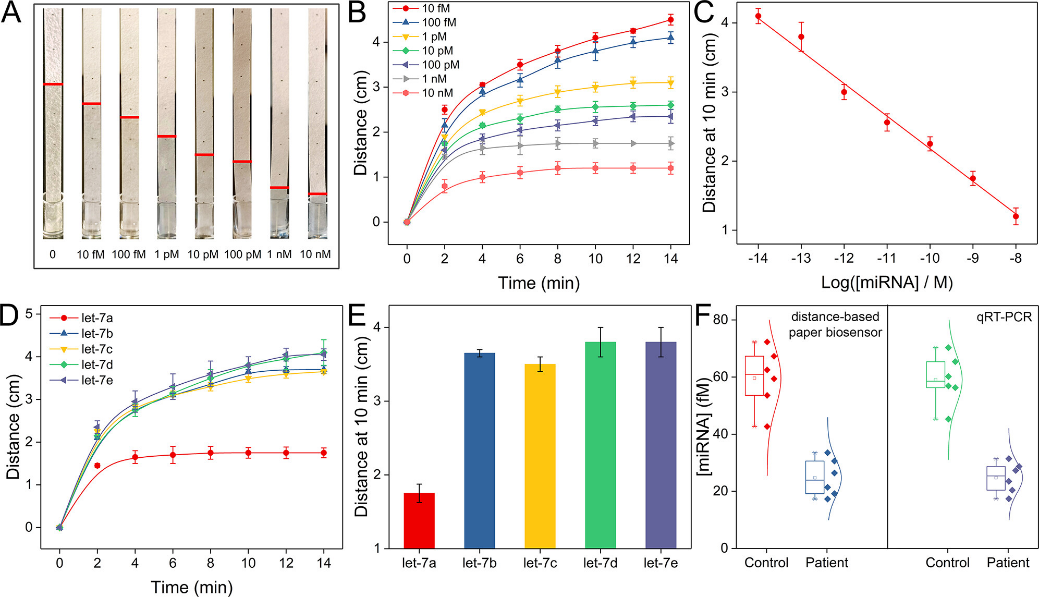
A. Photograph of filter strips after the reactions with different amounts of miRNA; B. Seepage flow distances of DNA hydrogel induced by miRNA; C. Linear relationship; D. Flow distances of DNA hydrogel induced by let-7a and the family members; E. Comparison of the flow distances; F. Concentrations of miRNA in control and patient samples. (Image by SIBET)