2024


The genus Aeschynanthus, commonly known as lipstick plants, contains about 170 species. Currently, 36 known species of Aeschynanthus are known in China, 14 of which are endemic.
Researchers from the Xishuangbanna Tropical Botanical Garden (XTBG) of the Chinese Academy of Sciences encountered and collected a brownish-yellow flowering plant of Aeschynanthus, during the botanical surveys in the China-Myanmar transboundary region in Yunnan, China between 2020 and 2023. After extensive morphological comparisons with several similar species from China and neighboring countries, the researchers agree that the unknown plant is new to science.
They named the new species as Aeschynanthus wangii in honor of Prof. WANG Wen Tsai (W.T. Wang, 1926–2022), who made significant contributions to the flora of China. Results were published in Taiwania.
Aeschynanthus wangii is an epiphytic sub-shrub, pendulous and branched. It grows on moist, shady tree trunk surfaces in evergreen forests at about 1,200–1,900 m elevation. It is morphologically similar to A. angustioblongus and A. stenosepalus, but differ significantly from them in having lanceolate leaves with a long caudate apex, a brownish yellow corolla with five dark red lines from the middle of the corolla tube to the top of the lobes, and calyx lobes slightly fused with the calyx tube at the base.
"An examination of the specimens revealed that the earliest specimen of this species was collected by Mr. ZHU Taiping in 1958 in Canyuan County, Yunnan, and was not collected again for nearly fifty years until it was re-collected by several collectors after 2006; but none of these specimens were correctly identified," said TAN Yunhong of XTBG.
Aeschynanthus wangii was only found in several populations in the Yunnan Nanggunhe Nature Reserve and the Yunnan Tongbiguan Provincial Nature Reserve. The researchers cannot conclude whether it is relatively common or rare. Therefore, they assessed the conservation status of the new species as data deficient according to the International Union for Conservation of Nature standard.

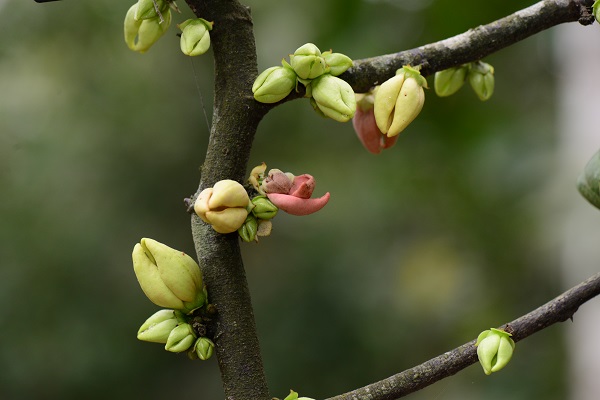
Aeschynanthus wangii (Image by DING Hongbo)

Aeschynanthus wangii (Image by DING Hongbo)

Aeschynanthus wangii (Image by DING Hongbo)

Aeschynanthus wangii (Image by DING Hongbo)