2023


L-Ascorbic acid (Asc), commonly known as Vitamin C (Vc), is an essential nutrient that plays a crucial role in many physiological processes. Previous studies have shown that Vc improves the efficiency of somatic cell reprogramming through pathways such as cell proliferation, mesenchymal-epithelial transition (MET), and histone demethylation. However, it is unclear whether Vc directly regulates reprogramming or acts through its metabolites.
In a study published in Cell & Bioscience, the team led by Dr. ZHENG Hui from the Guangzhou Institutes of Biomedicine and Health (GIBH) of the Chinese Academy of Sciences (CAS) revealed that Vitamin C regulates the reprogramming of somatic cells through a dual pathway that is dependent and independent of its metabolite 2,3-diketo-L-gulonic acid (DKG).
During somatic cell reprogramming, somatic cells were treated with Vc and its metabolites, including dehydroascorbic acid (DHAA) and DKG. It was found that Vc exhibits a dual capacity to promote reprogramming through both DKG-dependent and -independent pathways. On the one hand, Asc facilitated reprogramming by promoting cell proliferation and inducing the conversion from pre-induced pluripotent stem cells (pre-iPSCs) to iPSCs through DKG-independent pathways. On the other hand, Vc triggers MET and activates glycolysis through a DKG-dependent mechanism.
Notably, the researchers found that DKG alone activated a non-canonical tricarboxylic acid cycle characterized by increased succinate, fumarate, and malate, prompting the cell metabolism to shift from oxidative phosphorylation (OXPHOS) to glycolysis.
In addition, they found that due to its antioxidant capacity, Vc inhibits glycolysis, thereby preventing the positive feedback between glycolysis and epithelial-mesenchymal transition (EMT), ultimately leading to higher levels of MET.
This study demonstrated the intricate functions of Vc in the reprogramming process, revealed the dual regulatory effects of Vc on the DKG-dependent and -independent processes during reprogramming, and provided new insights for the application of Vc in other biological processes.
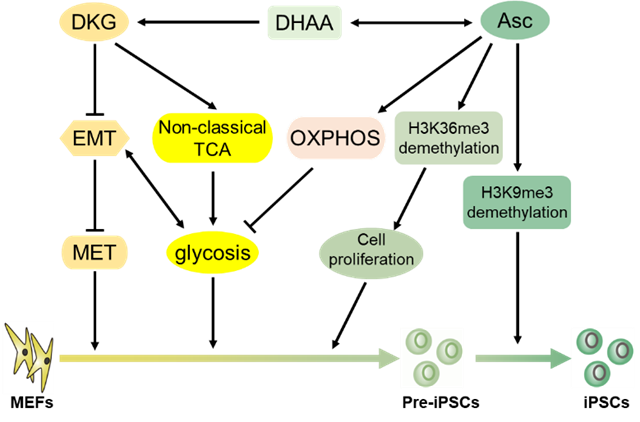
Vitamin C regulates somatic cell reprogramming through DKG-dependent and -independent pathways. (Image by GIBH)