2023


A recent study published in Scientific Reports has made progress in understanding the relationship between coronal rotation, magnetic structures, and the driving forces behind variations in solar coronal rotation. It was conducted by XIANG Nanbin from the Fuxian Solar Obsevatory of Yunnan Observatories of the Chinese Academy of Sciences (CAS), along with ZHAO Xinhua from the National Space Science Center of CAS, and Prof. DENG Linhua from Yunnan Minzu University.
Solar rotation, a fundamental characteristic of the Sun, is second only to the Schwabe cycle, an approximately 11-year cycle, in prominence. The energy and matter of the solar atmosphere originate from the Sun’s interior, driving the rotation of the solar atmosphere from the inside out. Historically, based on the Sun’s overall behavior, early studies supported that the rotation of the upper solar atmosphere would not exceed that of the lower solar atmosphere.
However, with the accumulation of observational data, recent studies have suggested a contrasting perspective: the rotation of the corona, the Sun’s outermost layer, is faster than that of the underlying photospheric atmosphere. The two conflicting views have sparked a scientific debate with the faster rotation of the corona compared to the underlying photospheric atmosphere remaining an unsolved mystery. As researchers continue to delve into this enigma, stay tuned for more updates on this captivating facet of solar physics.
In this study, researchers discovered that solar activities, both violent and gradual, are influenced by magnetic activities. These activities occur at various altitudes within the solar atmosphere and are linked to distinct categories of magnetic fields.
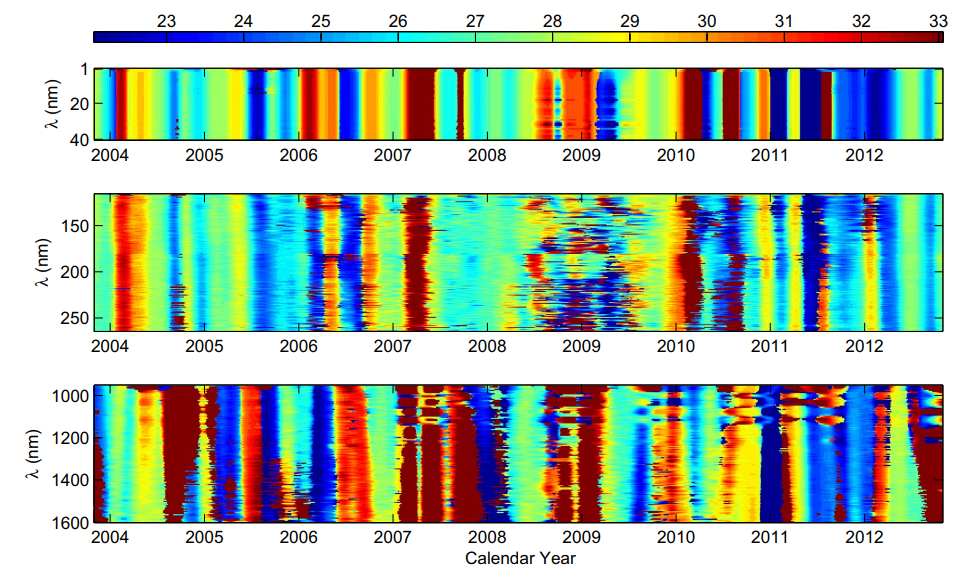
The researchers focused on four categories of solar small-scale magnetic elements: those with no correlation to the sunspot cycle, those with an anti-correlation to the sunspot cycle, those transitioning from anti-correlation to correlation with the sunspot cycle, and those in-phase with the sunspot cycle. Utilizing a wide broad of solar spectral irradiances, they explored the relationship between coronal rotation and magnetic field structures.
For the first time, the impact of different magnetic structures on the temporal variation of rotation in the coronal atmosphere during different phases of the solar cycle was documented. The researchers found that during the solar maximum, the temporal variation of rotation in the coronal plasma atmosphere was primarily influenced by small-scale magnetic elements that showed an anti-correlation with the sunspot cycle. However, during periods of relatively weak solar activity, it was shaped by the combined effects of both the small-scale magnetic elements with an anti-correlation and those in-phase with the sunspot cycle.
This study not only provides an explanation for the previously inconsistent results from studies on coronal rotation but also reveals why the coronal atmosphere rotates faster than the lower photosphere. It marks a significant advancement in the understanding of solar dynamics and their impact on the solar system.