
2023


Elephants, as the largest terrestrial mammals, are known for their distinctive feature - the flexible and agile trunk. Described as the most sensitive organ among vertebrates, an elephant's trunk has at least 40,000 muscles and a highly developed nervous system. However, the extent to which elephant ancestors possessed a trunk is difficult to ascertain due to a lack of direct fossil evidence. Early scientists noted that during the early evolution of elephants, including the Oligocene and Miocene epochs, various elephant species had significantly elongated lower jaws and lower incisors, especially during the early to mid-Miocene. How did these early elephant species use their diverse lower jaws and incisors for feeding, and what role did the trunk play in the feeding process?
In a latest study, scientists from the Institute of Vertebrate Paleontology and Paleoanthropology (IVPP) of the Chinese Academy of Sciences conducted a comprehensive study of the diversity and evolutionary history of the lower jaws in proboscideans, along with the co-evolution of the trunk. The results, published in eLife journal on Nov. 29, shed light on the unique evolutionary processes related to the feeding strategies of early elephant species and the associated anatomical adaptations.
According to the researchers, during the Middle Miocene Climatic Optimum, about 17-15 Ma years ago, the shovel-tusked elephant species, Platybelodon, had developed a feeding method in which it used its trunk to coil around plants and its lower jaw to cut them. This provides early evidence for the gripping function of the trunk in elephant feeding.
The researchers compared the functional morphology of three major long-jawed elephant groups-Amebelodontidae, Gomphotheriidae, and Choerolophodontidae. These species had distinct lower jaw morphologies: Platybelodon had shovel-like lower incisors, Gomphotherium had cylindrical lower incisors with enamel bands, and Choerolophodon lacked lower incisors but had elongated and grooved lower jaw joints.
In order to gain insight into the feeding habits and strategies of these early elephants, they used a variety of methods, including dental enamel stable isotope analysis and finite element mechanics. Stable isotope analysis provided evidence of different dietary preferences among the three elephant groups, while finite element mechanics helped reconstruct their feeding methods.
The results indicate that Platybelodon, Choerolophodon, and Gomphotherium exhibited distinct feeding behaviors and inhabited different environments. Platybelodon, which lived in more open environments, had a lower jaw suited for cutting vertically growing plants. It used its flexible trunk to grasp plants and then used its lower jaw for horizontal cutting, resulting in highly efficient feeding. Choerolophodon, adapted to relatively closed environments, were suited to cutting horizontally or diagonally growing branches. They used their trunks to press down branches, aided by the lower jaw during feeding. Gomphotherium, with an intermediate habitat preference, displayed diverse feeding methods that were well adapted to both forest and grassland environments.
The study emphasizes that elongated lower jaws and lower incisors were the primary feeding organs of early elephants, with the trunk serving as an auxiliary tool. Different early elephant species with distinct lower jaw morphologies exhibited varied ecological adaptations. As the climate gradually became cooler and drier, Platybelodon, which thrived in more open environments, played a crucial role in promoting the development of the grasping function and flexibility of the trunk.
The expansion of Platybelodon into open environments was interrupted by the Tortonian hyperthermal event in the Late Miocene, leading to extinctions, including Platybelodon. However, Gomphotherium replaced Platybelodon, continuing to spread into open environments until the Late Miocene. During the evolutionary process, the feeding function of elephants shifted completely to the trunk, ultimately resulting in the unexpected and simultaneous shortening of the once elongated lower jaws and lower incisors. Thus, the adaptability of feeding behavior in open environments acted as a catalyst for the evolution of the trunk's gripping function.
This study provides critical evidence for understanding the co-evolution of the trunk and lower jaw in proboscideans, offering new insights into how elephants adapted to their environment and how environmental changes shaped the evolution of their unique organs.

Finite element analyses of feeding behaviors among three longirostrine gomphothere families and reconstruction of their feeding ecology. (Image by IVVP)
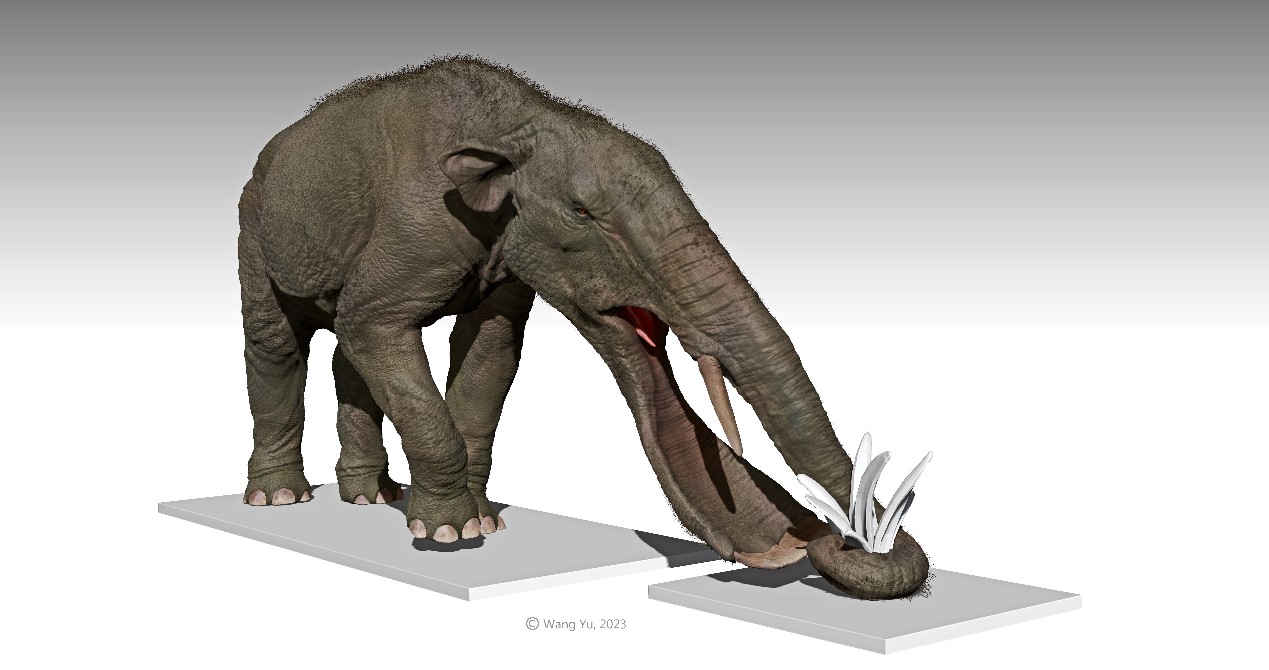
3D restoration model of the Platybelodon. (Image by IVVP)
