2023


Using solution-state nuclear magnetic resonance (NMR) technology, a group of scientists led by Prof. ZHANG Na from the Hefei Institutes of Physical Science of the Chinese Academy of Sciences has discovered a novel reassembly process for G-quadruplexes (GQs) through a new type of reaction called Hoogsteen pairing-based strand displacement reaction (Hoogsteen SDR).
Conventional Watson-Crick SDR involves the displacement of one strand of a double-stranded DNA or RNA helix by a single-stranded homologous invading strand, based entirely on the principle of the Watson–Crick base pairing rule. GQs, which are non-canonical secondary structures formed by guanine-rich nucleic acid fragments, can exist in various forms such as monomeric or intermolecular assemblies. Well-folded GQs are highly stable and resistant to SDR with other guanine-rich strands.
"Our work is the first to describe the spontaneous reassembly of GQ via Hoogsteen pairing-based SDR and to present a novel NMR solution structure of heteromeric tri-GQ with a unique mode of two probes versus one target," said Prof. ZHANG.
In this study, the team focused on a specific target sequence of Tub10 d(CAGGGAGGGT), which was a DNA fragment from the G-rich promoter region of the human β2-tubulin gene.
In a K+ solution, the Tub10 sequence self-folds into a parallel homomeric dimolecular GQ (di-GQ) with high thermal stability. Using Hoogsteen pairing-based SDR, the researchers introduced a pair of short G-rich probes (P1 d(TGGGA)) to penetrate the Tub10 GQ. Through this process, they were able to reassemble the starting di-GQ into a novel parallel heteromeric trimolecular GQ (tri-GQ) of Tub10/2P1.
This study not only provided the first NMR solution structure of a discrete heteromeric tri-GQ but also revealed a unique mode of recognition between two probes and one target among G-rich DNA fragments. The short G-rich probe P1 showed higher specificity for GQ targets compared to conventional antisense probes.
Furthermore, P1 served as a model system by effectively capturing the G-rich target Tub10 from a Watson-Crick duplex formed when Tub10 hybridized with its complementary strand.
These findings open up new possibilities for the reassembly of GQs and provide insight into the interaction between G-rich DNA fragments, according to the team.
This work was supported by the National Key Research of China, the Development Program of China and the National Natural Science Foundation of China.
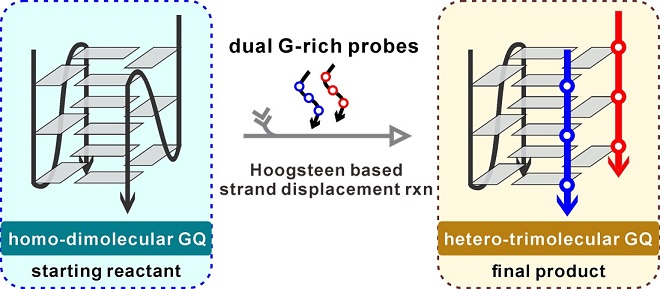
Figure 1. Schematic illustration of the spontaneous Hoogsteen pairing-based strand displacement reaction between one homo-dimolecular GQ target and dual G-rich invading probes at room temperature, yielding the final product of heteromeric trimolecular GQ. (Image by ZHANG Na)
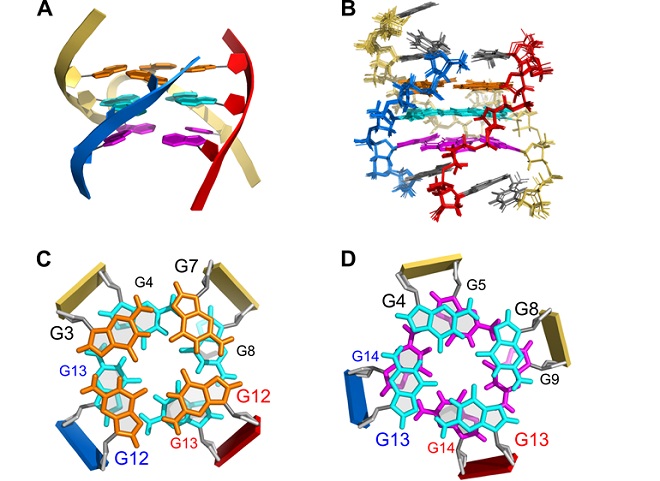
Figure 2. NMR solution structure of the heteromeric tri-GQ of Tub10/2P1. (Image by ZHANG Na)