2023


According to a study published in Redox Biology, researchers from the Hefei Institutes of Physical Science of the Chinese Academy of Sciences found, for the first time, that dietary arachidonic acid (AA) increases the occurrence of radiation-induced intestinal injury (RIII).
RIII is a common gastrointestinal complication (incidence rate is about 80%) caused by radiotherapy of pelvic, abdominal, and retroperitoneal tumors. It may lead to the interruption of radiotherapy. At present, there are no uniform and effective methods for clinical treatment of RIII. Therefore, determining the pathogenesis of RIII is an important prerequisite for developing the strategies for RIII treatment.
In this study, the researchers used RNA sequencing analysis to investigate the possible involvement of ferroptosis in the intestinal tissue of RIII mice. They found that the levels of lipid peroxidation markers, 4-hydroxynonenal (4-HNE) and malondialdehyde (MDA), were significantly elevated in these mice.
The researchers also discovered that Ferrostatin-1 (Fer-1), a ferroptosis inhibitor, mitigated both death and intestinal fibrosis in RIII mice. In addition, in cultured intestinal epithelial cells, organoids and mouse models, the researchers found that AA, the omega-6 essential fatty acid, is a key factor in radiation-induced ferroptosis. Exogenous AA induced radiation-induced ferroptosis.
Subsequent mechanistic studies revealed that the activation of STAT1-IRF1 positively regulated the expression of ACSL4, which promoted the occurrence of ferroptosis after irradiation. On the other hand, the AMP-activated protein kinase (AMPK) signaling pathway was activated by AA and played a negative regulatory role in radiation-induced ferroptosis.
The above results indicated that the STAT1-IRF1-ACSL4 and AMPK signaling pathways were potential molecular targets for the strategies development of RIII prevention and treatment. Arachidonic acid, an essential dietary fatty acid, was an important risk factor for ferroptosis-mediated RIII. This study also suggested that targeted dietary nutrition control, which was expected to alleviate RIII, should be implemented during radiotherapy.
This work was supported by the National Natural Science Foundation of China, the Hefei Comprehensive National Science Center, and the Key Research and Development Project of Anhui Province.
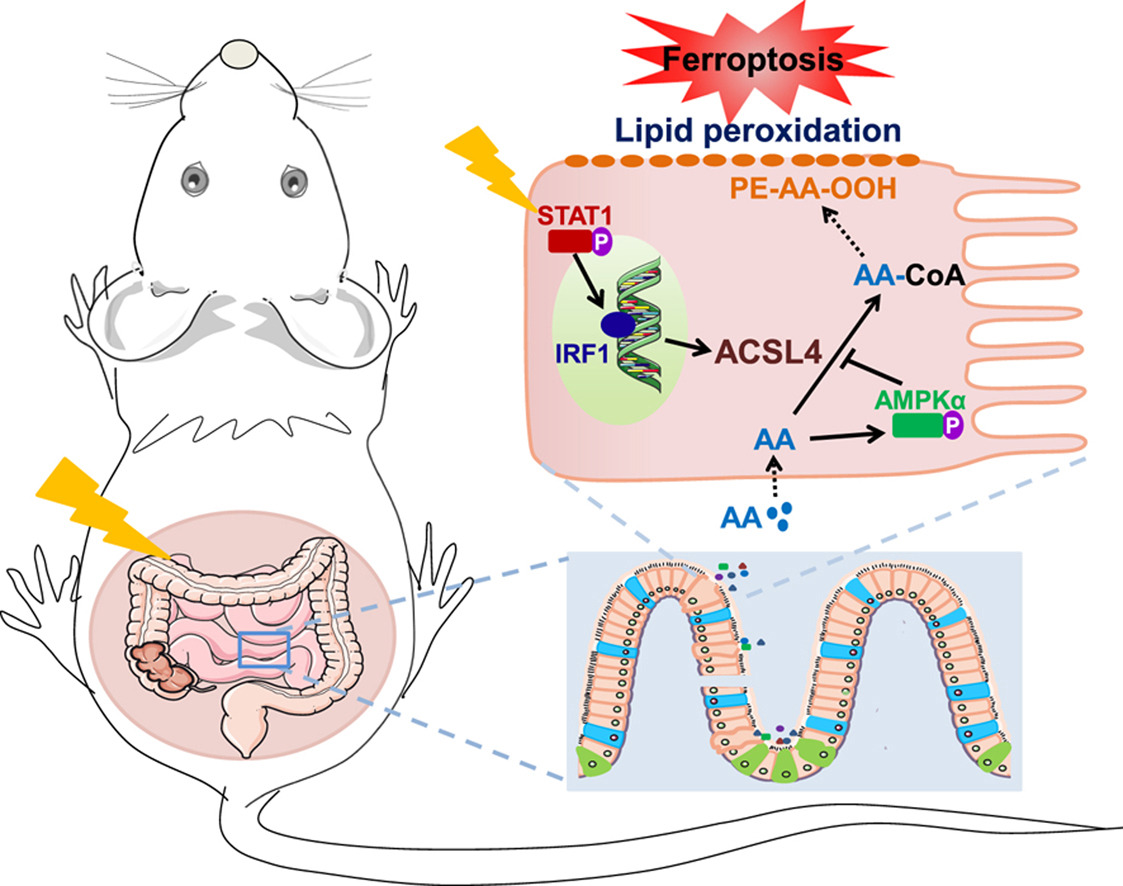
Mechanism of ferroptosis mediated radiation-induced intestinal injury. (Image by NIE Lili)