Spike traits are essential morphological structures that play a key role in crop yield and are therefore the subject of intense research interest. The genetic relationship between grain characteristics and other spike traits is of paramount importance as it determines the allocation of assimilates, the products of plant photosynthesis. This allocation has a direct effect on crop yield. Despite the importance of wheat as a global cereal crop, research into assimilate allocation has been relatively limited, and the underlying genetic mechanisms remain unclear.
In a collaborative study, researchers used a mapping population of 306 wheat accessions representing global genetic diversity. They also used 40 million high-quality single-nucleotide polymorphism (SNP) data to perform genetic analyses of wheat spike traits.
This comprehensive study, which involved GUO Zifeng's group from the Institute of Botany of the Chinese Academy of Sciences (CAS), LU Fei's group from the Institute of Genetics and Developmental Biology of CAS, MA Youzhi's group and HAO Yuanfeng's group from the Chinese Academy of Agricultural Sciences, was published in the journal
Genome Biology on Aug. 28.
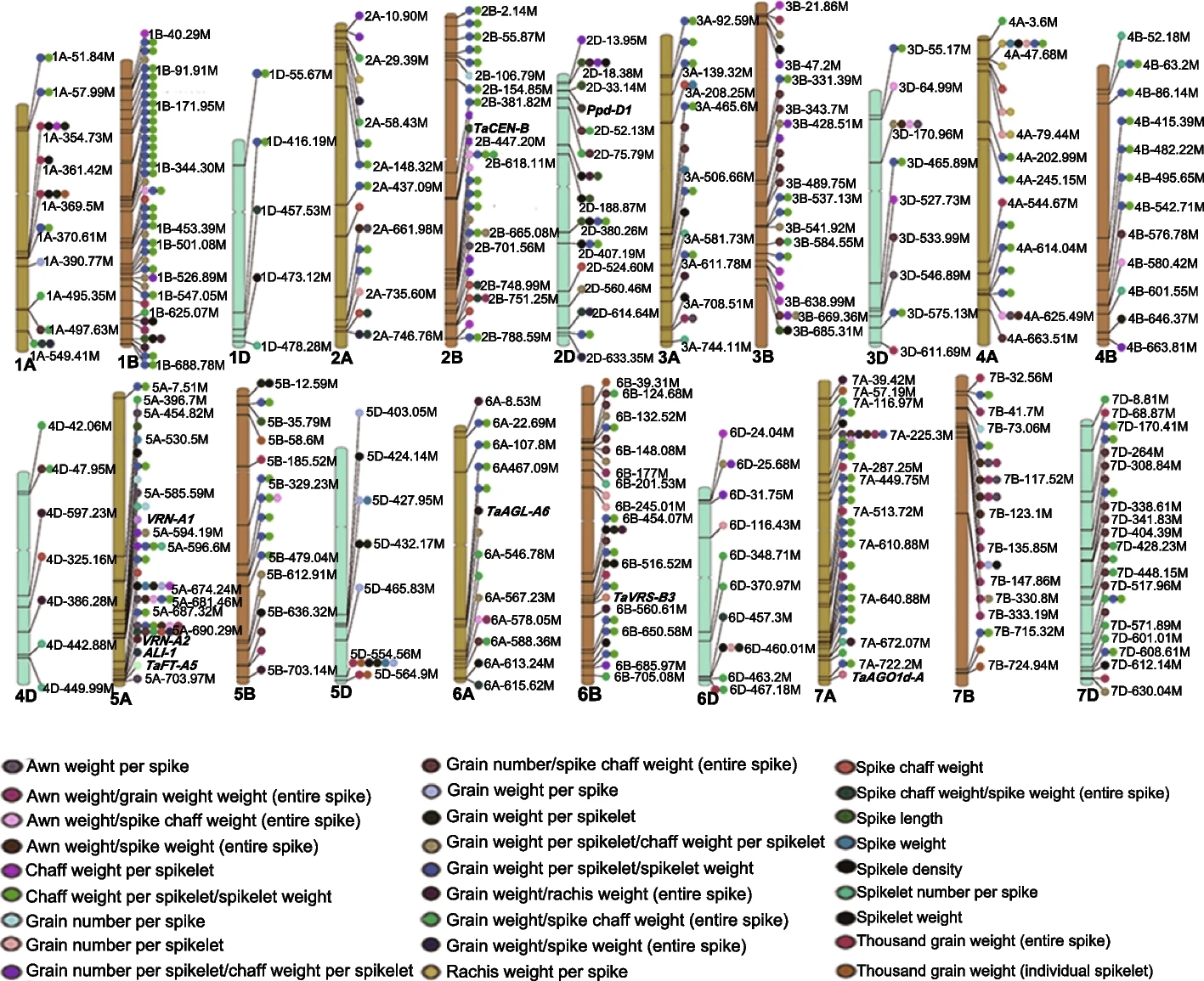
In this study, the researchers performed a genome-wide association analysis of 27 spike and grain traits and identified 590 associated genomic regions. Notably, 90% of these regions were newly discovered and represented valuable target loci for future spike trait dissection. Analysis of assimilate allocation traits within spikes revealed the presence of strong major effect peaks overlapping with yield trait peaks, as well as associated regions where yield traits were not previously identified.
The researchers used high-density SNPs to detect signals associated with genes or in close proximity to candidate genes. They identified TaSPL17 as a candidate gene responsible for regulating assimilate allocation. Further investigations using mutagenesis and overexpression experiments confirmed that TaSPL17 controls grain size and quantity by regulating the development of spikelets and florets, ultimately leading to a significant increase in grain yield.
Subsequent haplotype analysis revealed distinct geographical distribution differences for TaSPL17, influenced by domestication and breeding selection. In particular, the Hap-A2 haplotype was predominantly found in Chinese varieties; however, its prevalence in modern wheat varieties has gradually decreased due to reduced use in Chinese wheat breeding programs. Nevertheless, Hap-A2 has significant potential for increasing wheat yield and remains an important target for future research.
This study has established a high-density genotype-phenotype map specifically for wheat spike traits, providing a valuable resource for rapid discovery and evaluation of candidate genes associated with wheat spike traits.
This study was supported by the Strategic Priority Research Program of CAS, the Agricultural Science and Technology Innovation Program, the National Key Research and Development Program, and the National Natural Science Foundation of China, among others.
Genotype-Phenotype Association Map of 27 Spike Traits. (Image by IGDB)