The state of chromatin, influenced by chromatin modifications, contributes to the epigenetic control of the eukaryotic genome functions. Thus, the stability of eukaryotic genomes relies on the faithful transmission of both genetic and epigenetic information by DNA replication. However, chromatin reassembly after DNA replication is challenging because it involves the recycling of modified parental histones and the incorporation of predominantly unmodified new histones. This process can result in the dilution of chromatin modifications that are critical epigenetic marks, requiring their restoration after replication.
Plant TONSOKU (TSK) and its animal orthologue TONSOKU-like (TONSL) have been identified as key players in maintaining DNA integrity by acting as readers for newly synthesized histones and facilitating DNA repair at post-replicative chromatin. Mutations in TONSL have been associated with human disease. However, whether TSK/TONSL is involved in epigenetic inheritance remains unclear.
A recent study conducted by a team led by Dr. JIANG Danhua from the Institute of Genetics and Developmental Biology (IGDB) of the Chinese Academy of Sciences shed light on this issue. The study showed that TSK plays a vital role in maintaining several repressive chromatin modifications in the model plant Arabidopsis thaliana, revealing a novel function of TSK in supporting epigenetic inheritance.
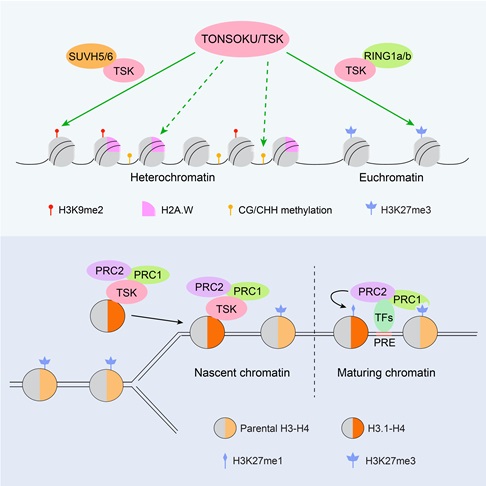
In this study, they found that TSK is dispensable for global histone and nucleosome accumulation, but necessary for the maintenance of repressive chromatin modifications, including H3K9me2, H2A.W, H3K27me3, and DNA methylation.
Further analysis revealed that tsk mutation strongly enhanced the defects in the Polycomb mutants, suggesting their coordination in maintaining H3K27me3 and Polycomb silencing.
In addition, TSK physically associates with the H3K9 methyltransferases SUVH5 and SUVH6, as well as the Polycomb proteins RING1a and RING1b, implying that TSK may recruit them to nascent chromatin to restore chromatin modifications.
These results suggest that TSK ensures the maintenance of chromatin modifications by facilitating the recruitment of chromatin modifiers during a critical period when TSK is briefly loaded onto the nascent chromatin.
In conclusion, the results of this study demonstrate that TSK has a dual role in regulating both DNA repair and epigenetic stability. These findings highlight the importance of further investigating the function of TONSL and the pathogenesis of diseases associated with TONSL mutations.
TSK assists in the maintenance of repressive chromatin modifications and may directly recruit chromatin modifiers onto the nascent chromatin (Image by IGDB)