2023


To quickly obtain the spatiotemporal distribution images of volatile organic compounds (VOCs) in water, a research team led by Prof. HUANG Ying from the Hefei Institutes of Physical Science of the Chinese Academy of Sciences developed a shipborne mass spectrometry system for monitoring VOCs in water.
The results were published in Journal of Cleaner Production.
VOCs in water not only affect microbial growth, but also contribute to air pollution and harm human health. Understanding the distribution of VOCs in water is critical to understanding pollution, managing water bodies, and improving the environment. However, traditional detection methods are time-consuming and cannot provide rapid insight into the spatial and temporal characteristics or emission sources of VOCs in water.
The shipborne mass spectrometry system developed in this research can monitor VOCs in water. The spray extraction-proton transfer reaction mass spectrometry technique applied in this system helps researchers to quickly and online extract and monitor VOCs in water in real time.
What's more, the system can integrate their component and concentration information with geographic information system (GIS). It enables real time visualization of the spatial distribution of VOCs in water. In this way, it was possible to quickly visualize and trace the sources contributing to the distribution of VOCs in water.
In a field test, the researchers verified its potential application. The system can be installed on ships to conduct large-scale surveys of VOC distribution in water bodies and trace VOC emissions in rivers. It can also be installed at specific locations for real-time monitoring and early warning of VOCs in water, such as pipelines and rivers.
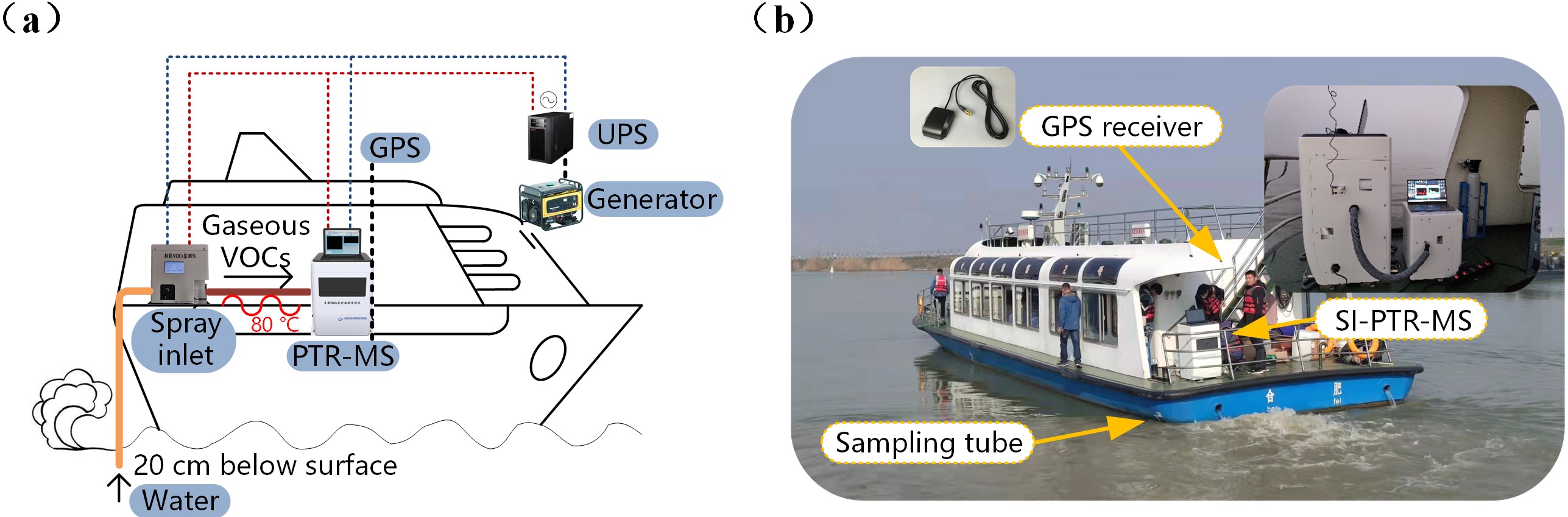

Diagram of S-SI-PTR-MS and the VOC distribution and fingerprints in Chaohu Lake. (Image by Liang Qu)