2023


A research team led by Prof. LYU Bo from the Hefei Institutes of Physical Science of the Chinese Academy of Sciences has improved the diagnostic accuracy of X-ray Crystal Spectroscopy (XCS) and investigated a series of fusion reactor-related spectral lines on tungsten (W) and xenon (Xe) at the Experimental Advanced Superconducting Tokamak (EAST).
Rotation velocity and ion temperature profiles are fundamental to various plasma physics studies. Currently, XCS on EAST can provide local radial profiles of the above parameters by analyzing argon (Ar) spectra with a newly developed inversion technique. However, as plasma parameters increase, Ar spectra will be insufficient for diagnostic purposes in the future.
The researchers conducted extensive research on the W impurity spectra based on XCS, which enables the measurement of core plasma rotation velocity and ion temperature for fusion reactors. By optimizing the wavelength observation range of the diagnostic system, developing an inversion method for the W impurity radiation profile, and using in-situ intensity calibration techniques, the researchers obtained multiple spectral lines related to W impurity.
Furthermore, one of the key physical and technical challenges currently facing fusion research is how to control the W impurity concentration within an acceptable range. Physical experiments focused on W impurity control were performed on the EAST facility. The above method allowed for the direct observation of the mitigating effect of radiofrequency core heating on impurity accumulation.
In addition, a feasibility study was conducted to measure the high-parameter plasma ion temperature and rotation velocity by analyzing the Xe spectral profiles. First, the feasibility was confirmed by the atomic physics simulation program. Then, Xe spectral lines consistent with theoretical predictions were measured for the first time in the EAST physics experiment, allowing the determination of ion temperature and other ionization parameters through Xe impurity spectral line analysis.
Overall, this work contributes to the advancement of plasma physics research, enhances the XCS diagnostic capabilities on EAST, and provides valuable insights into the XCS diagnostics of plasma in fusion reactor scenarios.
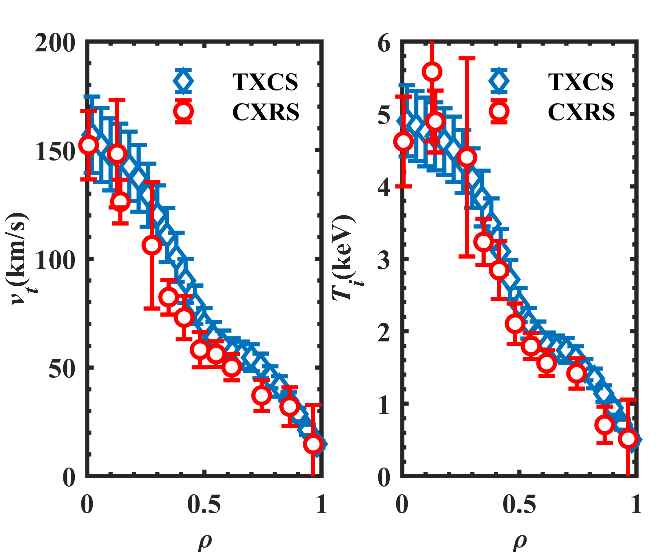
Inverted rotation velocity and ion temperature profiles by XCS compared with Charge Exchange Recombination Spectroscopy (XCRS). (Image by LIN Zichao)
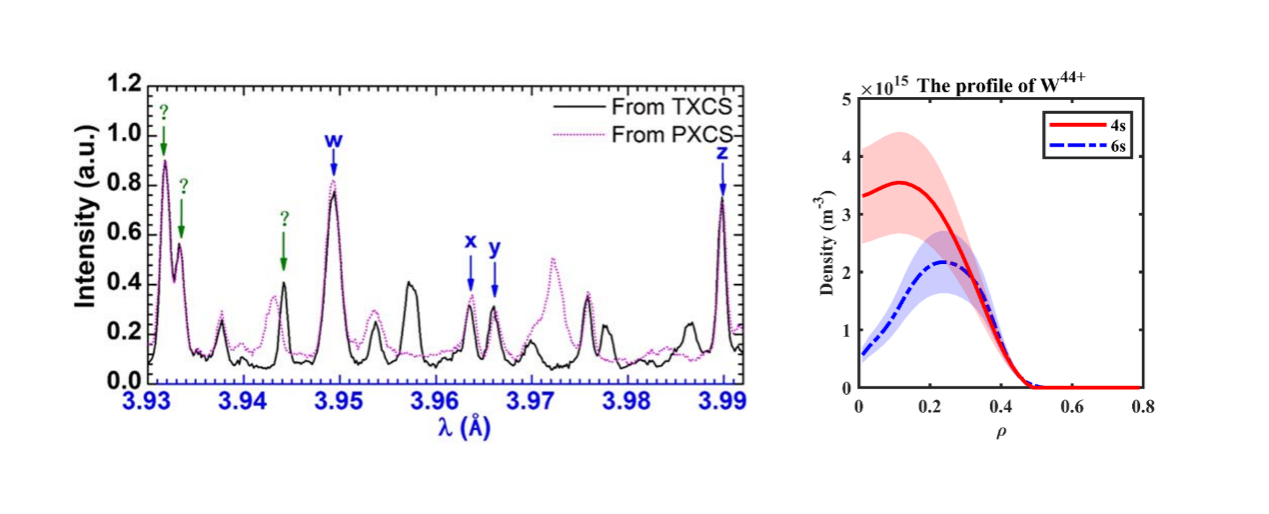
Left. Typical spectral lines measured by the XCS on EAST; Right. The impurity density profiles of W44+. (Image by LIN Zichao)