2023


Researchers led by Prof. ZHANG Weijun from the Hefei Institutes of Physical Science (HFIPS) of the Chinese Academy of Sciences (CAS) have found that a decrease of about 35% of single scattering albedo (SSA) at 365-405 nm would cause a 46% decrease in direct radiative forcing (DRF) efficiency at ground albedo.
The relevant research work was published in Science of the Total Environment.
Brown carbon (BrC) is an important light-absorbing carbonaceous aerosol that is very good at absorbing near-ultraviolet and visible radiation. Its ability to absorb radiation depends on the wavelength, which has a major impact on the local and global radiation budget. BrC mist is formed when BrC is released into the air and then oxidized again. Biomass combustion is a major source of the main BrC in the air. The spectral properties of BrC from burning biomass are uncertain due to the limitations in measurement methods, leading to large uncertainties in the assessment of BrC radiative forcing.
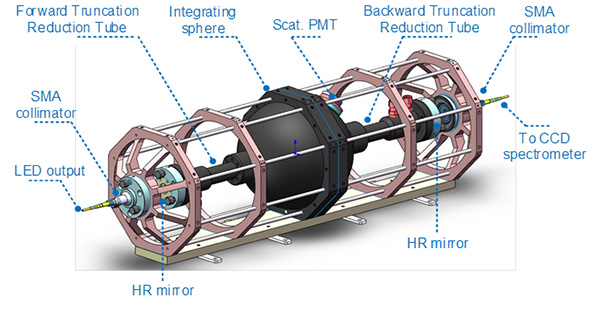
In this study, the researchers used a four-wavelength broadband cavity-enhanced albedometer that they had developed.
The albedometer was operated at four independent wavelengths: 365, 405, 532, and 660 nm.
The albedometer can be used to measure the extinction coefficient, scattering coefficient, absorption coefficient, and SSA of BrC emitted from wood pyrolysis. These optical parameters obtained online can effectively reflect the changes in aerosol during biomass pyrolysis.
"Based on the above multi-wavelength in-situ measurement, we developed the SSA spectrum retrieval method," said ZHOU Jiacheng, who invented the albedometer, "and we obtained the broad spectral characteristics of the primary BrC in the range of 300-700 nm with it."
The SSA spectrum can be used to evaluate the DRF of primary BrC. The DRF efficiency over the ground of various primary BrC emissions increased from 5.3 % to 68 % as compared to the assumptin of non-absorbing organic aerosol assumption.
This study highlights the importance of BrC spectral properties in radiative forcing assessment, which has important scientific implications for accurate assessment of aerosol climate impacts.
This work was supported by the National Natural Science Foundation of China, the Natural Science Foundation of Anhui Province, the Youth Innovation Promotion Association of CAS, and the HFIPS Director's Fund.
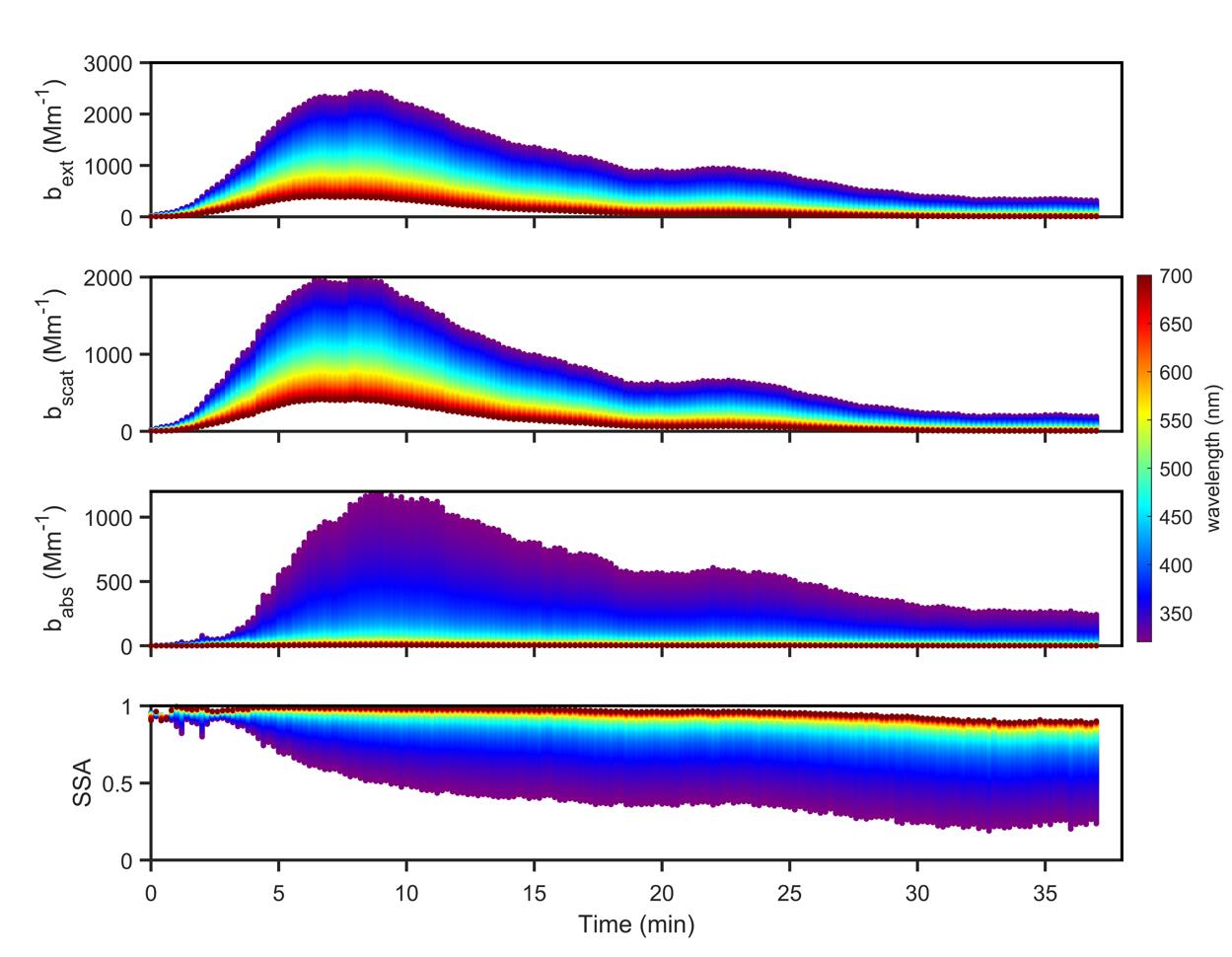
Spectral characteristics of extinction coefficient, scattering coefficient, absorption coefficient, and SSA of BrC aerosol from biomass pyrolysis. (Image by ZHOU Jiacheng)
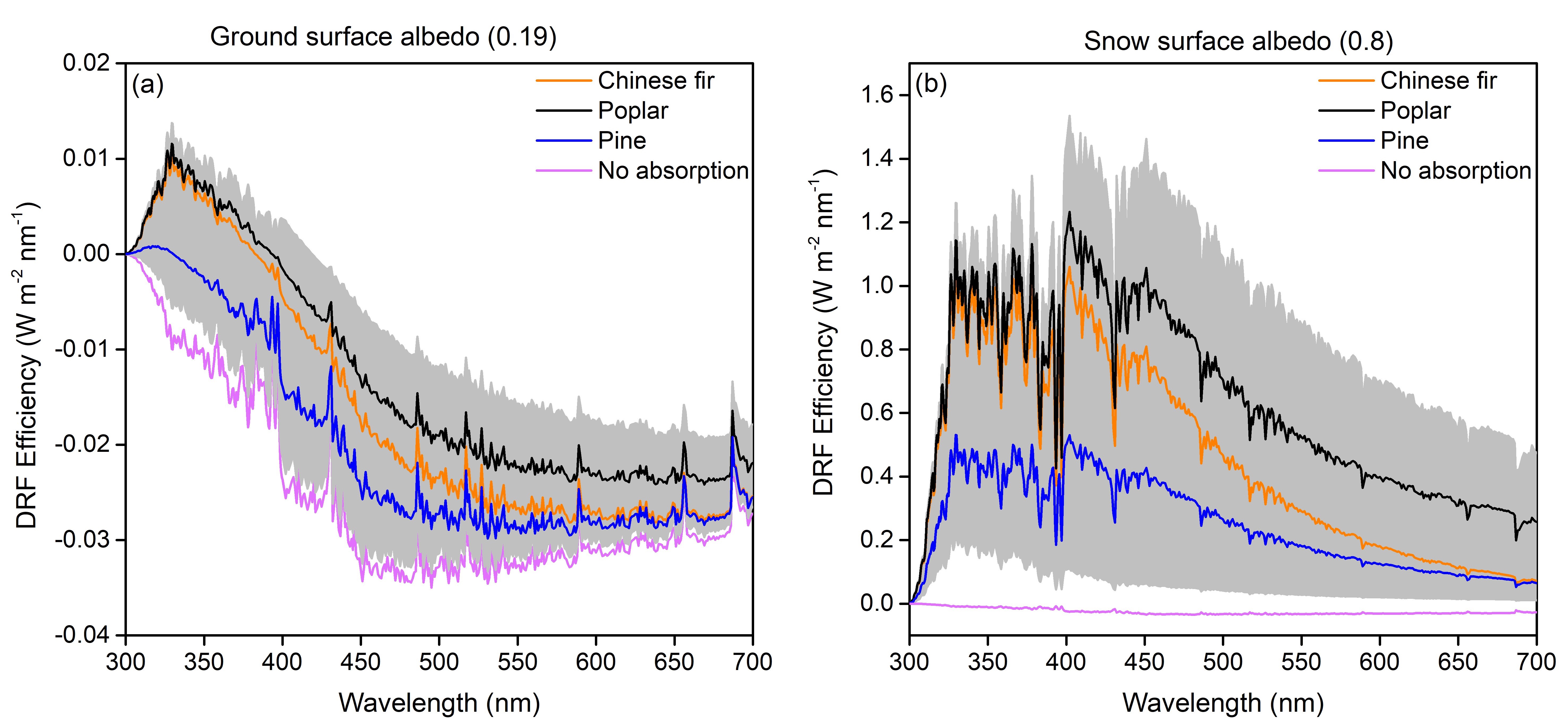
The DRF of BrC aerosol above ground surface albedo and snow surface albedo. (Image by ZHOU Jiacheng)