
2022


Ion-interference therapy which utilizes ions to disturb intracellular biological processes provides inspiration for tumor therapy. Artificially reversing osmotic pressure by transporting large amounts of physiological ions to tumor cells is a straightforward yet low-toxic strategy for ion-interference therapy. However, the short circulation lifetime, dose-limiting systemic toxicity, and poor selectivity toward tumors make it unavailable to achieve the single ion delivery.
In a study published in ACS Nano, the research group led by Prof. LIU Xiaolong from Fujian Institute of Research on the Structure of Matter of the Chinese Academy of Sciences developed a virus-mimicking and glutathione (GSH)-responsive hollow mesoporous tetrasulfide-bridged organosilica (ssss-VHMS) to skillfully delivered NaCl nanocrystals to tumor sites and sequentially realized the explosive release of Na+ inside tumor cells.
Owing to the spike surface-assisted endocytosis, the ssss-VHMS-wrapped NaCl nanocrystals could rapidly invade tumor cells bypassing Na+/K+-ATPase transmembrane ion transporters. The intracellular overproduced GSH of tumor cells could trigger the rapid degradation of ssss-VHMS, which would not only remarkably deplete the GSH but also explosively release the Na+, resulting in the osmolarity surge accompanied by the reactive oxygen species (ROS) generation.
Specifically, the researchers demonstrated that the cell swelling, ROS storm, and GSH exhaustion induced by NaCl@ssss-VHMS efficiently eradicated tumor cells, due to the caspase-1-dependent pyroptosis, caspase-3-dependent apoptosis, and GPX4-dependent ferroptosis, respectively, thus synergistically inhibiting tumor growth.
This discovery provides a perspective for exploring synergistic ion-interference therapy.
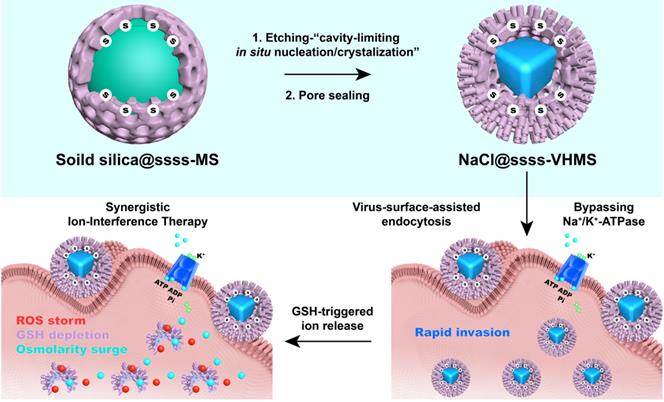
Schematic Illustration of the Research (Image by Prof. LIU’s Group)
