
2022


There is a continuum spectrum of organizational complexity in extant animal societies, among which the human societies and those established by social insects (termites, wasps, bees and ants) are of great prominence. Social insects are fundamentally different from humans in the sense, their societies are composed of different castes whose morphologies are differentiated through development and social roles largely pre-determined before adult life.
Ants are the most evolutionarily successful and ecologically dominant animal lineages. The evolutionary success of ants can largely be attributed to their social living life styles. A typical ant colony consist of the following castes: worker, queen, gyne (virgin queen) and male. Different cell types are specialized for different functions and integrated as a whole. In parallel, an ant colony has its reproductive caste and worker caste. Different castes take on different social roles and integrated into an indivisible unit – a “superorganism”.
In a study published in Nature Ecology and Evolution, researchers from Kunming Institute of Zoology of the Chinese Academy of Sciences and Beijing Genomics Institute, Shenzhen, reported comprehensive single-cell transcriptomic atlas of pharaoh ant brains, which revealed the different anatomical features and brain cellular compositions across castes in a pharaoh ant colony, and reported the brain cellular dynamics accompanying the reproductive maturation of an ant queen and interrogated the neural mechanisms underlying its remarkable fecundity and longevity phenotypes.
The brain specialization for social life
To address the neural mechanisms underlying division of labor in an ant superorganism, researchers leveraged the single-cell sequencing technique to interrogate brain cell compositions of pharaoh ants. 206,367 high-quality single cell transcriptomes were obtained in total, covering the full panel of pharaoh ant castes – worker, gyne, queen and male were all surveyed. A comprehensive brain single cell transcriptomic atlas was generated and 43 different cell types were identified.
The brain anatomies and cell compositions of the four different castes were compared. Male and worker had extremely specialized brain forms. Worker had the most abundant mushroom body Kenyon cells (the brain center responsible for higher cognitive functions such as learning and memory) and olfactory projection neurons while the least abundant vision related optic lobe neurons. The cellular composition of male brain was of opposite trends. Male had the least abundant Kenyon cells and olfactory projection neurons while the most abundant optic neurons. Gyne/queen had the intermediate brain forms with moderate abundances for most cell types.
According to the observation, the worker may have better olfaction processing abilities, capable of cognitive demanding tasks and exhibit flexible behavioral strategies. In contrast, the specialized male brain may well equip him to display the stereotyped and extremely targeted mating behavior. The intermediate brain forms in gyne/queen may endow them with full behavioral repertoire which are barely good enough when they initially found new colonies and are reminiscent of the solitary living ancestor who must play totipotent roles without worker assistance.
The path to a queen remodels the brain
Compared with worker, the queen has dramatically extended lifespan, much longer than the similar sized solitary living insects. It was found that there were remarkable brain plastic changes happened to a queen induced by insemination. The dynamic change of the cellular composition in the queen brain may be correlated with her drastic physiological and behavioral shifts if successfully mated. The brain remodeling ultimately leads the queen to become an efficient and long-lasting egg-laying machine, realizing her full capacity of reproduction so that new generations of workforce can be generated for the colony.
This study unravels the neural basis of division of labor in ants and provides an example to dissect how sociality drive brain evolution in insects and other animals in general.
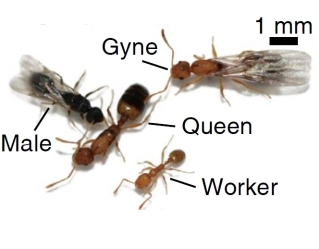
The full panel of pharaoh ant castes (Image by Kunming Institute of Zoology)
