
2022


As a potential representative of deep-sea sediments, fish teeth are rare earth element (REE)-rich materials in the world. However, their REE enrichment mechanism remains unclear.
Under the guidance of Prof. GUO Qingjun from the Institute of Geographic Sciences and Natural Resources Research of the Chinese Academy of Sciences, by analyzing high-resolution geochemical data, researchers found that fish teeth in the ocean contain a lot of valuable information. And they reconstructed the REE enrichment mechanism based on deep-sea REE cycling.
Fish teeth exposed to pore water had higher adsorption capacity. It absorbed abundant REEs from the surrounding pore water during early diagenesis, according to Dr. DENG Yinan, member of the team.
"The geochemistry of rare earth elements in fish teeth has been traditionally regarded as a robust proxy for reconstructing ancient seawater chemistry," said Prof. GUO.
The researchers also found that the benthic fluxes between the shallow marine realm and deep-sea differed greatly in their effects on REE.
"However, by analyzing high-resolution rare earth element and yttrium data of pore water, bottom water, and fish teeth, we found that the depth distribution of REEs in pore water is opposite to that of fish teeth. REE patterns and neodymium (Nd) isotopic compositions are not uniformly distributed within the fish teeth," said Prof. GUO.
This study indicates that REE and Nd isotopic compositions were altered during early diagenesis. And REEs from fish teeth are not robust recorders of deep marine environment throughout Earth's history.
This work was published in Science Advances with the title of "Early diagenetic control on the enrichment and fractionation of rare earth elements in deep-sea sediments" on June 22.
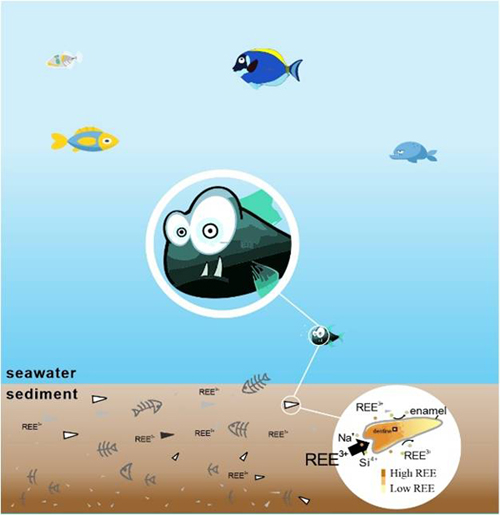
Model of accumulation of REY in deep-sea. (Image by Prof. GUO Qingjun's group)
GUO Qingjun
Institute of Geographic Sciences and Natural Resources Research
E-mail: guoqj@igsnrr.ac.cn
