2022


Peach is one of the most economically important fruit crops worldwide, which is characterized by fuzzy skin due to the presence of trichome, while nectarine, as the subspecies of peach, is absent of trichome.
A fuzzy gene PpMYB25 has been proven to be a candidate for the G locus controlling the trichome in peach fruit. However, the underlying regulatory mechanism of PpMYB25 to fruit cuticle is far from known.
Supervised by Prof. HAN Yuepeng from the Wuhan Botanical Garden of the Chinese Academy of Sciences, Ph.D. student YANG Qiurui compared the difference between peach and nectarine fruit cuticle by scanning electron microscope and gas chromatography, and found that not only trichome, the structure and content of cuticle wax also had a great deal of variation.
A series of studies in transgenic and molecular biology have shown that PpMYB25 and its downstream homolog PpMYB26 not only control the formation of trichome in fruit, but also participate in the regulation of cuticle wax accumulation by activating the transcription of cuticular wax biosynthetic genes.
Inactivation of PpMYB25 and PpMYB26 leads to failure of trichome formation and reduced accumulation of cuticular wax, resulting in fuzzless and glossy fruit trait of nectarine.
This study unveils the transcriptional regulatory networks controlling fruit trichome initiation and cuticular wax biosynthesis in peach and enlightens molecular mechanisms underlying the origin of nectarine.
This work was published in New Phytologist entitled "TwoR2R3-MYBgenes cooperatively control trichome development and cuticular wax biosynthesis inPrunus persica".

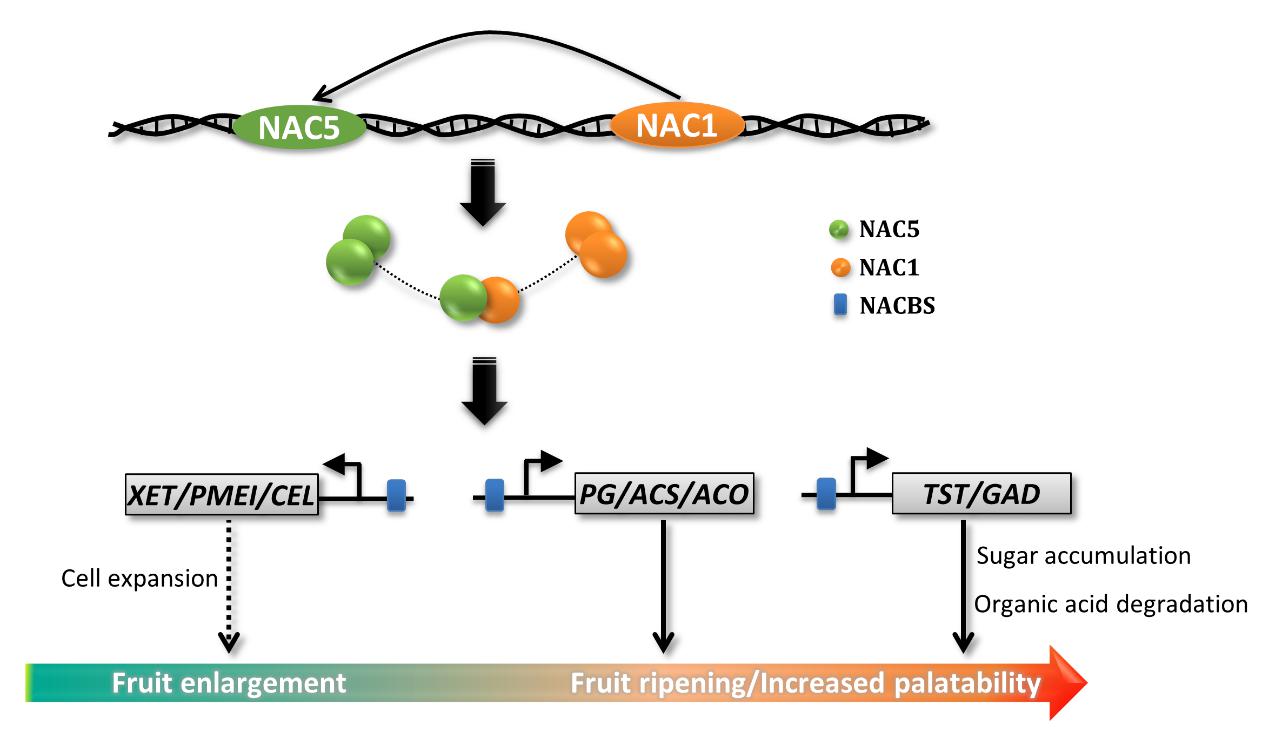
The regulatory network model of PpMYB25 and PpMYB26 in trichome and cuticular wax of peach fruit. (Image by YANG Qiurui)