News Archives


Senegalia catechu, generally known as Acacia catechu, blackcutch, catechu, and cachou, is a deciduous tree. It was considered as a traditional herbal medicine in India and China to treat diabetes. According to literatures, the anti-hyperglycemic activity of the bark, wood, and seeds from S. catechu had been investigated, however, little is reported on the hypoglycemic mechanism and corresponding constituent of Catechu.
In a study published in Journal of Ethnopharmacology, researchers from the Xishuangbanna Tropical Botanical Garden (XTBG) of the Chinese Academy of Sciences tried to explore its hypoglycemic effect and the possible hypoglycemic mechanism by conducting glucose uptake assay, α-glucosidase and α-amylase inhibition experiments.
Catechu is the dry water extract of barked branches or stems from S. catechu and has been used as a regulator for hypoglycemic in traditional research. The researchers tried to find the active constituents and explore its possible mechanism that supports traditional usage.
The researchers divided ethanol extract (EE) of Catechu into petroleum ether fraction of EE, ethyl acetate fraction of EE, and n-Butanol fraction of EE fractions by polarity, and detected their hypoglycemic activities via assays for α-glucosidase, α-amylase, and glucose uptake in adipocytes.
They then performed High-performance liquid chromatography-mass spectrometry (HPLC-MS) and in silico molecular docking investigations to analyze the primary active ingredients and the possible mechanisms against enzymes.
The results suggested that the hypoglycemic effect of Catechu might be related to the inhibitory effects of phenols ((-)-epicatechin, cyanidin, delphinidin, and their derivatives) on digestive enzymes.
"Our study provides scientific evidences for Catechu's traditional use to treat type 2 diabetes mellitus, a serious health problem that affects almost 400 million people worldwide and accounts for nearly 90% of all diabetes occurrences," said Prof. ZHANG Yumei of XTBG.
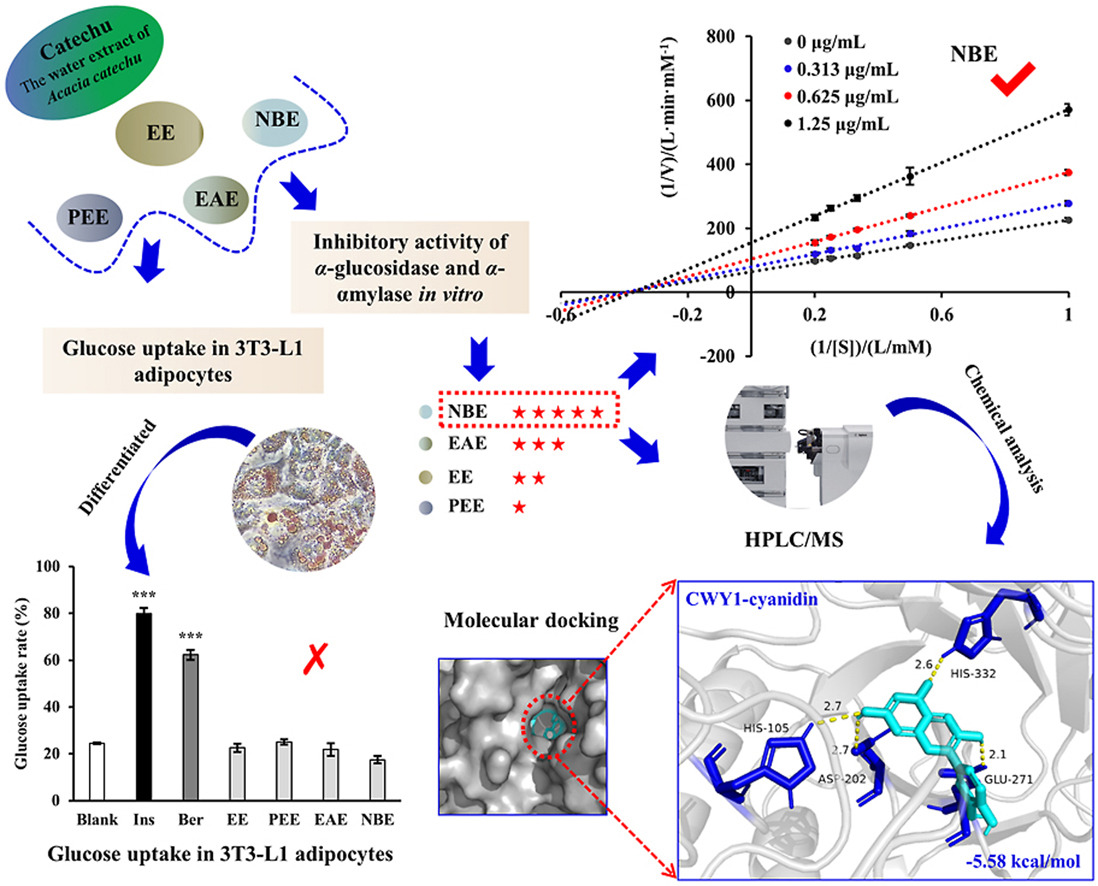
Antidiabetic potential of Catechu via assays for α-glucosidase, α-amylase, and glucose uptake in adipocytes. (Image by ZHANG Kun)