Newsroom


Southwestern China's Kunming city is home to rare orchid species. We follow our reporter Tao Yuan to see how scientists are protecting these prized flowers from extinction.
They are some of the most prized flowers in the world.
Rare colors.
Exquisite forms.
At the Kunming Institute of Botany, Chinese Academy of Sciences, hundreds of orchids are now on display.
But for decades, that beauty made them vulnerable.
Like this one, the apricot-yellow slipper orchid.
DR. ZHANG SHIBAO Professor, Kunming Institute of Botany, Chinese Academy of Sciences "It is incredibly striking and eye-catching. Once it was found, it drew attention from overseas. Then, many people came to Yunnan to dig it from the wild. Large numbers of wild plants were taken out and shipped through Hong Kong to Europe and the United States, causing serious damage to wild populations."
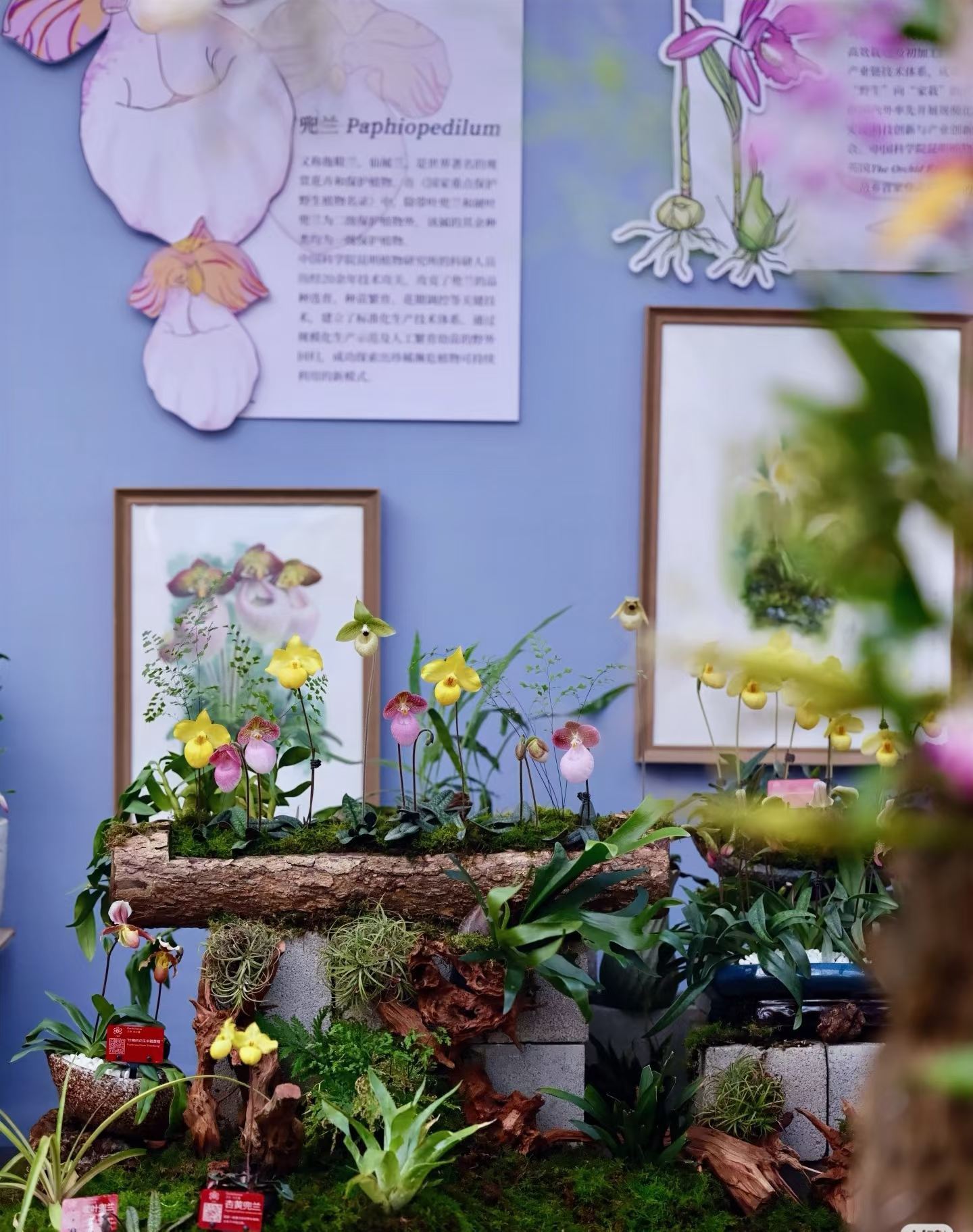
Orchid Show (Image by KIB)
For Zhang Shibao, that became the starting point of nearly three decades of work.
His team has been trying to solve a simple problem:
If people want these flowers, can science make them available without taking them from nature?
DR. ZHANG SHIBAO Professor, Kunming Institute of Botany, Chinese Academy of Sciences "If we can produce them on a large scale artificially, then people who want to see them or own them can buy beautiful plants at a low price. So there is naturally much less reason for anyone to go and dig them from the wild."
That begins with seeds that are almost too small to see.
Orchids have pushed their seed size to the biological minimum.
In the wild, they rarely survive.
DR. ZHANG SHIBAO Professor, Kunming Institute of Botany, Chinese Academy of Sciences "They have no endosperm, which means they cannot rely on their own stored nutrients to germinate. In nature, they depend on fungi to help them germinate, so their reproductive success is actually quite low."
In the lab, scientists place the seeds on a sterile, nutrient-rich gel.
DR. ZHANG SHIBAO Professor, Kunming Institute of Botany, Chinese Academy of Sciences "Different species need different hormones and different nutrients. So we have to run very detailed experiments to find the exact formula each plant needs in order to achieve efficient propagation."
And this is no longer just lab work.
Working with companies, Zhang Shibao's team has pushed orchid propagation to industrial scale.
Annual seedling production can now reach around five million.
LI HANRUN Engineer, Kunming Institute of Botany, Chinese Academy of Sciences "Behind that single plant that you buy for your home, many scientists have been working quietly for years. Their efforts are what make it possible for orchids to reach the market and be sold more easily, and at a more affordable price."
But the work doesn't stop when a plant thrives in cultivation.
DR. ZHANG SHIBAO Professor, Kunming Institute of Botany, Chinese Academy of Sciences "We also hope to return the seedlings we propagate back to the wild, let them flower there, and rebuild wild populations."
Since 2009, Zhang Shibao's team has returned more than 13,000 orchids back to the mountains.
So what's on display here is not just beauty.
But everything it took to keep them alive.
LI HANRUN Engineer, Kunming Institute of Botany, Chinese Academy of Sciences "The public can then understand that this is a protected plant, that it is so hard to come by, so difficult to protect, and so valuable and meaningful."
The science, the people, and the understanding that these flowers are worth more in the wild than in a pot. (CGTN)