
Large Research Infrastructures


A research team led by Prof. WANG Na from the Xinjiang Astronomical Observatory (XAO) of the Chinese Academy of Sciences (CAS) has conducted in-depth observations of the millisecond pulsar PSR J0435+3233 using the Five-hundred-meter Aperture Spherical radio Telescope (FAST).
The team found that PSR J0435+3233 has a markedly high spin-down rate—two orders of magnitude greater than that of any other known millisecond pulsar in the Milky Way. This property places the pulsar well above the "spin-up line" in the period–period-derivative diagram (P–Ṗ diagram). The pulsar also exhibits significant timing noise and an unusual orbital variation rate, suggesting the potential existence of a third celestial body within the system. These findings challenge the classical accretion-induced spin-up theory of millisecond pulsar formation.
The study was published in Nature Astronomy on April 8.
The researchers noted that key insights into an object's evolutionary history can be derived from its position in the P–Ṗ diagram, particularly its distribution relative to the Eddington spin-up line. This line marks the equilibrium between outward radiation pressure and inward gravitational force during accretion, representing the maximum stable accretion rate a neutron star can sustain—known as the Eddington accretion rate.
Conventional theory holds that millisecond pulsars form via a "recycling" process, in which neutron stars accrete material from a binary companion, gain angular momentum, and are spun up to millisecond rotation periods. All previously detected binary millisecond pulsar systems have been observed to lie below the spin-up line, in full agreement with theoretical predictions.
However, PSR J0435+3233 was observed to lie well above the "spin-up line" in the P–Ṗ diagram, strongly implying that millisecond pulsar formation may not follow a single accretion-driven spin-up channel. Instead, it likely involves multiple physical mechanisms that have not yet been fully understood.
Furthermore, typical millisecond pulsars are characterized by advanced age, weak magnetic fields, and highly stable rotation. These traits, confirmed across numerous observed systems, make them the most precise natural "clocks" in the universe. By contrast, PSR J0435+3233 features a younger characteristic age and a stronger surface magnetic field.
The researchers suggest that exotic processes—such as super-Eddington accretion onto a strongly magnetized neutron star or accretion-induced collapse of a magnetized white dwarf—may explain the formation of this young millisecond pulsar, which displays an elevated spin-down rate, intense magnetic field, and high energy loss.
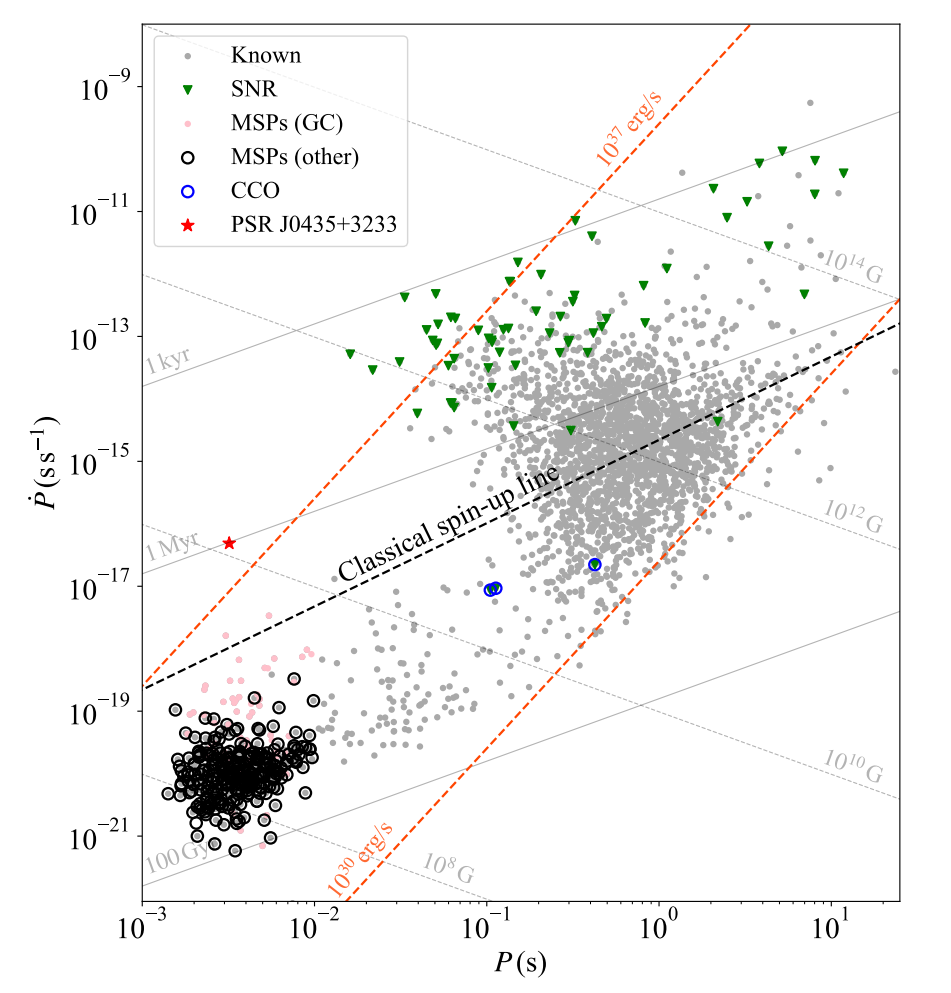
P-Ṗ diagram of known pulsars and PSR J0435+3233. (Image by WANG Na's team)
