

FU Qiaomei, a paleogeneticist at the Chinese Academy of Sciences, received the UNESCO–AI Fozan International Prize for the Promotion of Young Scientists in Science, Technology, Engineering and Mathematics (STEM) on June 19 in Paris, France.

A new study has identified a chemically peculiar star (LAMOST J1010+2358) in the Galactic halo as clear evidence of the existence of PISNe from very massive first stars in the early Universe, based on LAMOST survey and Subaru telescope.

A Chinese expedition team on Tuesday reached the summit of Mount Qomolangma, the world's highest peak, where they carried out scientific research. The feat came almost 70 years after man's first successful expedition to the top of the world, when New Zealander Edmund Hillary and Tenzing Norgay from Nepal summited Mt. Qomolangma from the south ridge on May 29, 1953.

Researchers have developed a strategy to disentangle the activity-selectivity tradeoff for direct conversion of syngas, a combination of primarily carbon monoxide and hydrogen, into desirable light olefins, which include ethylene, propylene and butylene, some of the most commonly used plastics precursors in the world.

Scientists from the Chinese Academy of Sciences have made tremendous achievements in the first quarter of 2023.
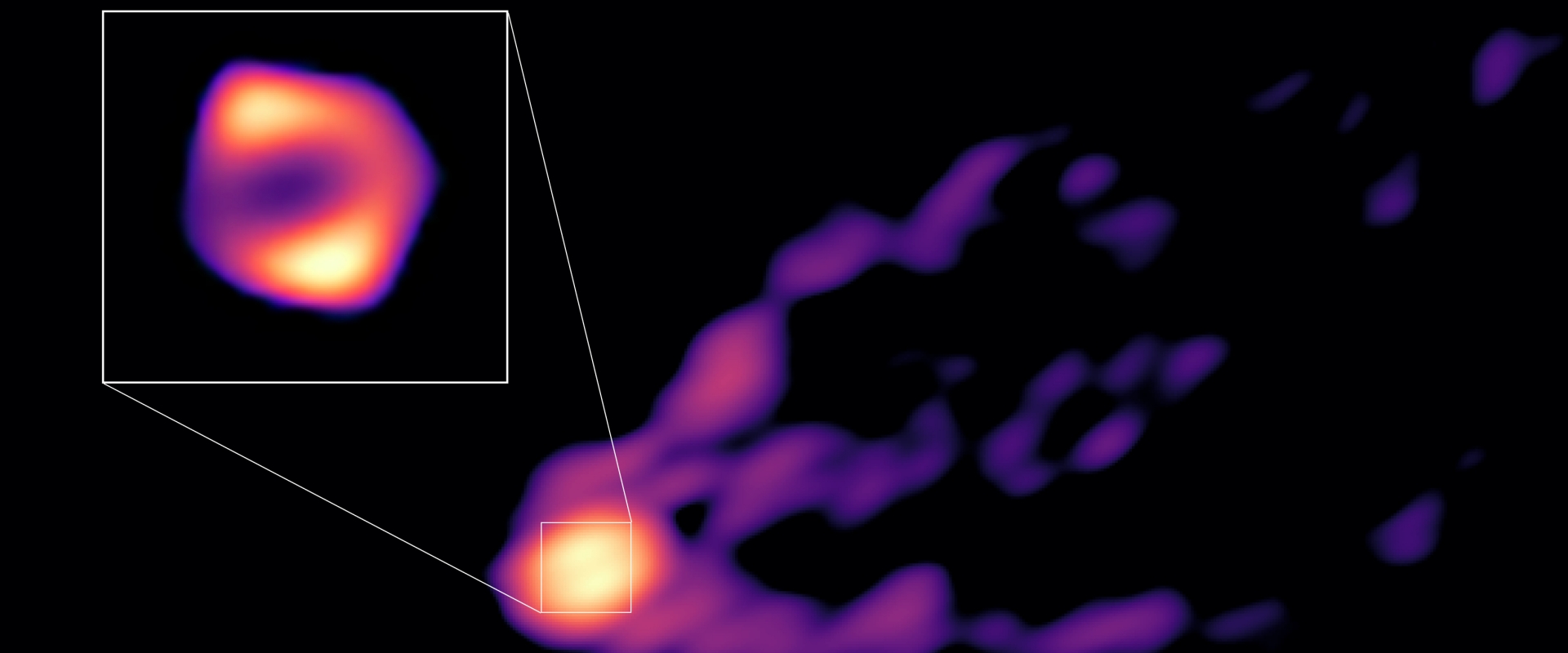
Scientists from the Shanghai Astronomical Observatory has used new millimetre-wavelength observations to produce an image that shows, for the first time, both the ring-like structure that reveals the matter falling into the central black hole and the powerful relativistic jet in the prominent radio galaxy Messier 87.

86-10-68597521 (day)
86-10-68597289 (night)

52 Sanlihe Rd., Xicheng District,
Beijing, China (100864)
Copyright © 2002 - Chinese Academy of Sciences


