
Tropical Biologists Gather for Regional Biodiversity Conservation
Biodiversity in the Asia-Pacific region is exceptionally rich, but unfortunately it is declining rapidly. For example, in the past 20 years, 22% of the land in Xishuangbanna, one of China’s most biodiverse regions, has been converted to rubber and tea plantations, resulting in large-scale fragmentation and habitat loss.
Humans face many challenges and need to work together to protect the region's biodiversity.
This is what brings tropical biologists and conservation scientists from countries in the Asia-Pacific region together at the 2017 Annual Meeting of the Association for Tropical Biology and Conservation (ATBC) Asia-Pacific Chapter, to explore ways to build conservation research capacity in the Asia-Pacific region.
More than 300 biologists and conservationists gathered together at the Xishuangbanna Tropical Botanical Garden (XTBG) to understand the evolution of biodiversity and discuss how to best conserve it under increasingly challenging conditions.
"Scientists have guided government wildlife and forestry policies, influenced the creation of new protected areas and advised on their management," said Prof. Antony Lynam, Chairman of ATBC Asia Chapter.
Scientists have also engaged in innovative collaborations to deploy integrated technology solutions to measure conservation effectiveness, and have helped shape the conservation agenda for a number of endangered species threatened with extinction, added Prof. Antony Lynam.
However, science alone may not be enough to save tropical biodiversity at dire risk of disappearing, and conservation sites and landscapes altered by human impacts, just as scientists said at the meeting.
"Protected areas are one of the main tools for stemming the ongoing global biodiversity crisis caused by habitat loss, fragmentation and other anthropogenic pressures," said Prof. ZHOU Jinfeng, Secretary-General of the China Biodiversity Conservation and Green Development Foundation.
According to ZHOU Jinfeng, non-government organizations (NGOs) are implementing new management models in order to ensure that the existing protected areas are successfully cared for and to encourage the wider community participation to proactively take collective responsibility for biodiversity conservation.
Cooperation between international research institutions and NGOs was therefore also discussed during the four-day meeting from March 25-28.
Joint efforts will be made to address the regional biodiversity conservation issues and ensure a better future for biodiversity in the region, according to Prof. CHEN Jin, Director of XTBG.
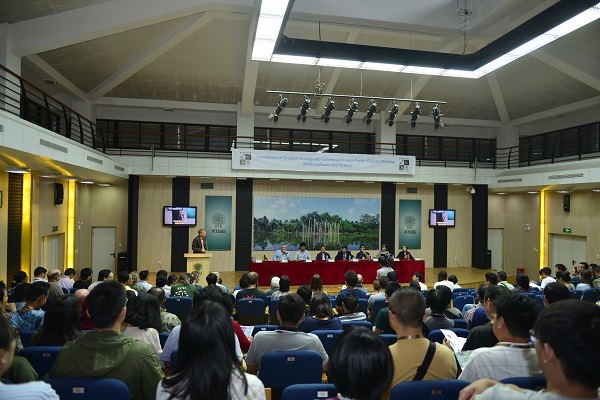
Annual meeting 2017 of the Association for Tropical Biology and Conservation (ATBC) Asia-Pacific Chapter at XTBG. (Image by DUAN Qiwu)
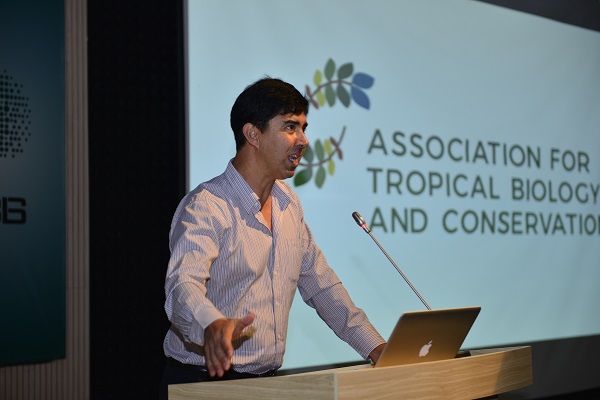
Prof. Antony Lynam, chairman of ATBC Asia Chapter, makes plenary presentation. (Image by DUAN Qiwu)

